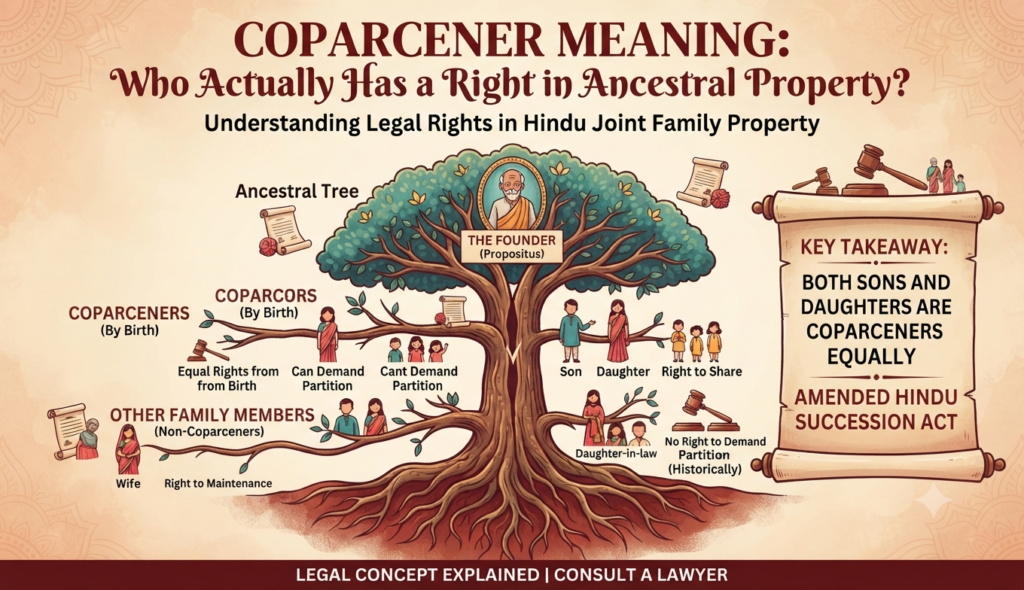
If you have inherited, or expect to inherit, a family property under Hindu law, the single most important word to understand is “coparcener.” The coparcener meaning in property is simple to state but powerful in effect: a coparcener is a family member who acquires a right in ancestral (coparcenary) property by birth — not by a will, not as a favour, but as a legal entitlement. Since a landmark 2005 amendment and a clarifying 2020 Supreme Court ruling, daughters have exactly the same coparcenary rights as sons.
What is a coparcener?
A coparcener is a person who is born into a Hindu Undivided Family (HUF) and, by that birth, gets an undivided interest in the family’s ancestral property. The concept comes from the Mitakshara school of Hindu law, which governs most Hindus in India (except in West Bengal and Assam, which follow the Dayabhaga school).
The word “coparcenary” describes a narrower body than the HUF itself. Traditionally the coparcenary consisted of a common ancestor and his lineal descendants up to three generations below him — that is, son, grandson and great-grandson. Every one of them held a right in the property from the moment they were born.
Coparcener vs HUF member: the crucial difference
People often use “HUF member” and “coparcener” interchangeably, but they are not the same. This is the difference between coparcener and HUF member that decides who can actually demand a share.
| Coparcener | HUF member | |
|---|---|---|
| How the right arises | By birth into the family | By birth or by marriage into the family |
| Right in ancestral property | Yes — an undivided share from birth | Only a right to maintenance, not a share |
| Can demand partition? | Yes | No |
| Typical examples | Son, daughter, grandchildren in the male line | Wife/mother (by marriage), daughter-in-law |
So every coparcener is a member of the HUF, but not every member is a coparcener. A wife, for instance, is a member of her husband’s HUF and is entitled to maintenance and a share on partition, but she is not a coparcener and cannot herself demand a partition. Her daughter, however, is a coparcener.
Daughter coparcener rights in HUF
The biggest change in a century came with the Hindu Succession (Amendment) Act, 2005, which amended Section 6 of the Hindu Succession Act, 1956. From 9 September 2005, a daughter of a coparcener became a coparcener in her own right — “in the same manner as a son” — with the same rights and the same liabilities in the coparcenary property.
Two questions troubled courts for years: did the father have to be alive on 9 September 2005, and did the daughter have to be unmarried? In Vineeta Sharma v. Rakesh Sharma (2020), a three-judge bench of the Supreme Court settled both. The court held that:
- A daughter’s coparcenary right is by birth. The father need not have been alive on 9 September 2005 for the daughter to claim.
- The right does not depend on the daughter’s marital status — married daughters are coparceners too.
- The right applies to daughters born before or after the 2005 amendment.
The main protection for the past is that partitions and dispositions of property already validly completed before 20 December 2004 are not reopened. Otherwise, daughter coparcener rights in ancestral property are now on an equal footing with sons.
Coparcener rights in ancestral property
A coparcener enjoys a bundle of rights that a mere member does not:
- Right by birth: an undivided interest in the coparcenary property from the moment of birth.
- Right to demand partition: a coparcener can ask for the joint property to be divided and their share separated.
- Right to survivorship (now modified): historically the share passed to surviving coparceners; after the 2005 amendment, a coparcener’s interest devolves by testamentary or intestate succession.
- Right to challenge improper alienation: a coparcener can object to a sale or gift of joint property made without legal necessity or consent.
- Right to accounts and joint possession.
It helps to be clear about what “ancestral property” means. It is property inherited up to four generations of the male lineage that has remained undivided. Self-acquired property that a person buys with their own income is not coparcenary property — the owner can gift or will it to anyone. Understanding these distinctions is as important as knowing your possession certificate when you take handover of a home, or checking the title chain through an encumbrance certificate before you buy.
How to claim your coparcener share in property
If you believe you have been left out of ancestral property, here is the broad route on how to claim coparcener share in property. Treat this as an orientation, not legal advice for your specific case.
- Establish that the property is coparcenary/ancestral — not the self-acquired property of one person. Gather title deeds, mutation records and the family tree.
- Send a formal partition demand to the other coparceners, ideally through a lawyer, stating your claim to a defined share.
- Attempt a family settlement — a registered partition deed or settlement is faster and cheaper than litigation.
- File a suit for partition in the civil court with jurisdiction over the property if talks fail. The court can order division by metes and bounds or sale and distribution of proceeds.
- Update the records — after partition, get mutation done and, where a share is transferred, note that a gift deed or settlement may attract stamp duty.
Because limitation periods, evidence of ancestral character, and prior partitions all matter, consult a property lawyer before acting. If you are buying rather than inheriting, you can browse verified residential projects and city guides on our portal to sidestep these complications entirely.
Frequently Asked Questions
What is the simplest coparcener meaning in property?
Can a married daughter claim coparcenary rights?
What is the difference between a coparcener and an HUF member?
Is self-acquired property coparcenary property?
How do I start a claim for my coparcener share?
This article is for general information only and is not legal advice; succession and coparcenary questions turn on the exact facts, so consult a qualified property lawyer and verify the current legal position before acting. Godrej Realty Homes is a property listings portal.