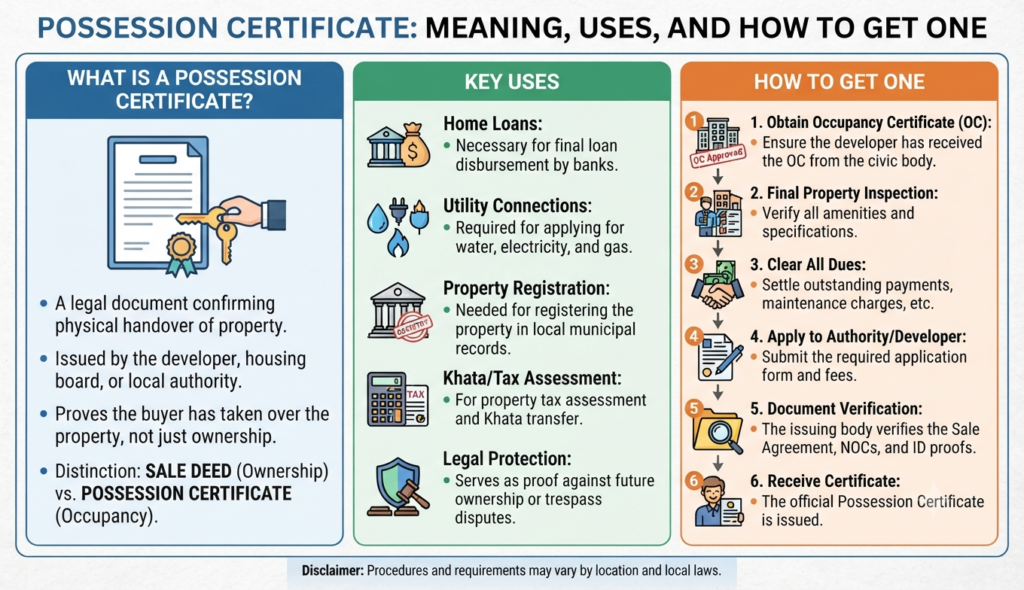
When you finally get the keys to a new home, one document formally marks that handover: the possession certificate. In simple terms, the possession certificate meaning is a written proof that the developer or seller has handed over physical possession of a property to the buyer on a specific date. It is a small document with big consequences — for your home loan, property tax, utility connections and future resale — so it pays to understand exactly what it is and how to get one.
Possession certificate meaning
A possession certificate (sometimes called a possession letter when issued by a builder) is an official document confirming that the rightful owner has been given physical possession of a property on a stated date. For a newly built flat, the builder issues it once the project has received its occupancy certificate and the buyer has cleared all dues. In some states, the revenue department or local authority issues a possession certificate for land or resettlement plots.
Crucially, a possession certificate records the handover of possession — it is not the same as ownership. Ownership is transferred by a registered sale deed. The possession certificate simply establishes that you are now in lawful physical occupation of the property.
Why the possession certificate matters
This document is more than a formality. You will need it at several important stages:
- Home loan disbursal: Banks release the final loan tranche for a completed property only after the possession letter confirms handover.
- Property tax and mutation: Local bodies use it to record you as the occupant and start tax assessment in your name.
- Utility connections: Electricity, water and gas providers often ask for it before transferring or issuing connections.
- Move-in and interiors: It marks the legal date from which you can occupy and renovate the home.
- Resale and disputes: It forms part of the property’s document trail and helps establish your timeline of possession.
Difference between possession certificate and sale deed
Buyers frequently confuse these two documents. They serve different purposes and you typically need both.
| Aspect | Possession Certificate | Sale Deed |
|---|---|---|
| What it proves | Physical handover of possession | Legal transfer of ownership |
| Issued by | Builder / seller / local authority | Executed between buyer and seller |
| Registration | Usually not registered | Compulsorily registered at sub-registrar |
| Legal weight | Evidence of occupation | Primary proof of title |
Think of it this way: the sale deed makes you the owner, while the possession certificate confirms you have actually received the keys. A registered encumbrance certificate check and the sale deed together establish clean title; the possession certificate completes the handover record.
How to get a possession certificate
For a flat from a builder
- Ensure the project has received its occupancy certificate (OC) from the local authority — a builder cannot legally hand over possession without it.
- Clear all outstanding dues: the final instalment, maintenance deposit, and any registration or statutory charges.
- Do a joint inspection (snagging) of the flat and get pending work fixed.
- Request the possession letter from the builder; it should state your name, the flat details, the project, and the exact date of handover.
- Collect the keys along with the signed possession letter and keep copies for your loan and records.
For land or a resettlement plot (government-issued)
- Apply to the relevant revenue office (tahsildar) or the state’s e-district / land records portal.
- Submit the sale deed, identity proof, tax receipts and any allotment order.
- After verification, the authority issues the possession certificate, often downloadable online.
Always cross-check the flat’s actual measured area against what you paid for; our guide on RERA carpet area explains what you are entitled to at handover.
Possession certificate for a home loan
For a ready or newly completed home, the possession certificate is a key document in the loan file. Lenders release the final disbursement only once they have proof that the property has been handed over and is fit for occupation, alongside the occupancy certificate and registered sale deed. If you are financing your purchase, keep the possession letter ready for the bank, and use a home loan EMI calculator to plan repayments from the possession date, since your full EMI usually begins once the loan is fully disbursed.
What to check before accepting possession
- The builder has a valid occupancy certificate for the tower or building.
- The possession letter states the correct flat number, area, and handover date.
- All amenities promised in the agreement are ready or covered by a written commitment.
- You have completed a snag inspection and listed any defects in writing.
- Your sale deed is registered, or a clear timeline for registration is agreed.
If you are still deciding between a completed home and one that is being built, the possession timeline is central to that choice — our comparison of under-construction vs ready-to-move flats walks through the trade-offs.
Frequently Asked Questions
What is the meaning of a possession certificate?
Is a possession certificate the same as a sale deed?
How do I get a possession certificate for my flat?
Do I need a possession certificate for a home loan?
Is a possession certificate legally valid proof of ownership?
This article is for general information only and is not legal advice. Document requirements vary by state and developer — verify the current process with the relevant local authority or your legal advisor before acting. Godrej Realty Homes is a property listings portal.