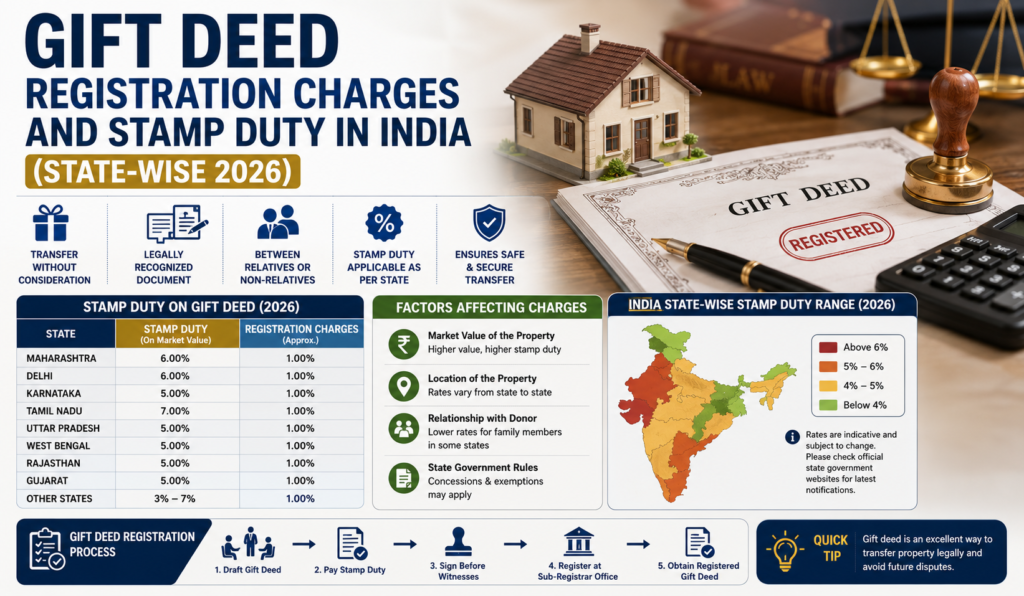
Transferring property to a family member without selling it is usually done through a gift deed — and to make it legally valid, you must register it. If you are wondering how to register a gift deed for property, the process involves drafting the deed, paying stamp duty and registration charges, and registering it at the sub-registrar’s office. The catch is that the cost varies sharply from state to state.
This guide explains the step-by-step registration process, the state-wise stamp duty and registration charges for 2026, the big concessions for blood relatives, and how a gift deed compares with a will.
What is a gift deed?
A gift deed is a legal document through which an owner (the donor) voluntarily transfers ownership of property to another person (the donee) without any money changing hands. To be valid under the Transfer of Property Act, the gift must be made voluntarily, accepted by the donee during the donor’s lifetime, and — for immovable property — registered under the Registration Act, 1908. An unregistered gift deed of immovable property does not pass legal title.
How to register a gift deed for property
The registration process is broadly the same across India, with the fees differing by state:
- Draft the deed: Prepare a gift deed stating the donor and donee details, relationship, a full property description, and a clear declaration that the transfer is voluntary and without consideration.
- Value the property: Stamp duty is charged on the market/circle (ready-reckoner) value, so obtain the applicable government valuation.
- Pay stamp duty: Buy stamp paper or pay stamp duty online through your state’s registration portal at the applicable rate.
- Book an appointment: Visit the local sub-registrar’s office with the donor, donee, and two witnesses.
- Execute and register: All parties sign the deed; biometrics/photos are captured, and the registration fee is paid.
- Collect the registered deed and update mutation records in the local municipal/revenue office.
Keep identity proofs (Aadhaar, PAN), property documents, the latest tax receipt, and passport photos ready. Many states let you calculate and pay duty online first — for example through IGRSUP in Uttar Pradesh.
Gift deed registration charges: state-wise (2026)
Stamp duty is a state subject, so rates differ widely. The biggest factor is whether the gift is to a close blood relative — many states charge a nominal or flat duty for family transfers but full rates for gifts to others. Registration fees are typically around 1% of value (sometimes capped).
| State | Gift to blood relative | Gift to others |
|---|---|---|
| Maharashtra | Rs 200 (residential/agricultural to spouse, child, grandchild, son’s widow) | 3% of market value |
| Uttar Pradesh | Flat Rs 5,000 (specified relatives) | 5%–7% |
| Karnataka | Fixed Rs 1,000–5,000 (by property value/location) | 2%–5% (as per sale slab) |
| Delhi | 4% (female) / 6% (male) — no separate family concession | 4%–6% |
| Tamil Nadu | Around 1% | 7% |
| West Bengal | Around 0.5% | 5%–6% |
| Telangana | Around 1% | 4% (approx.) |
| Gujarat | Concessional for close family (state notification) | Around 3.5%–4.9% |
| Rajasthan | Concessional to close family (varies by notification) | 5%–6% |
Rates change frequently and often have conditions and caps. Treat the above as indicative and confirm the current figure on your state’s registration portal before executing the deed. For city-level detail, see our guides to stamp duty in Pune and property registration charges in Bengaluru.
Stamp duty on gift deed to family members
The definition of “blood relative” or “family member” eligible for concessional duty varies by state but usually covers spouse, children, parents, siblings, and sometimes grandchildren and a son’s widow. To claim the concession you generally must:
- State the exact relationship in the deed.
- Attach proof of relationship (such as ration card, birth certificate, or family register entry) where the state requires it.
- Ensure the property type qualifies — some concessions apply only to residential or agricultural property.
Because the savings can run into lakhs on a high-value property, it is worth confirming the exact eligibility rules with the sub-registrar or a local advocate before drafting.
Gift deed vs will for property transfer
Both transfer property within a family, but they work very differently:
| Aspect | Gift deed | Will |
|---|---|---|
| When it takes effect | Immediately, during the donor’s lifetime | Only after the owner’s death |
| Registration | Mandatory for immovable property | Optional (registration recommended) |
| Stamp duty | Payable now (concessional for relatives) | None |
| Revocability | Generally irrevocable once accepted | Can be changed any time before death |
| Disputes | Harder to challenge once registered | More prone to contest |
A gift deed gives the recipient immediate, secure ownership but locks in the transfer and costs stamp duty upfront. A will is flexible and free of duty but only operates after death and can be disputed. Choose based on whether you want to transfer now or after your lifetime. If you are comparing legal instruments, our explainer on GPA in property covers another commonly confused option.
Frequently Asked Questions
Is registration of a gift deed compulsory?
How much stamp duty is charged on a gift deed to a family member?
What documents are needed to register a gift deed?
Can a registered gift deed be cancelled?
Is a gift deed or a will better for transferring property?
This article is for general information only and is not legal advice. Stamp duty and registration charges change often and vary by state, so verify the current figures on the relevant official government registration portal before executing a gift deed. Godrej Realty Homes is a property listings portal.