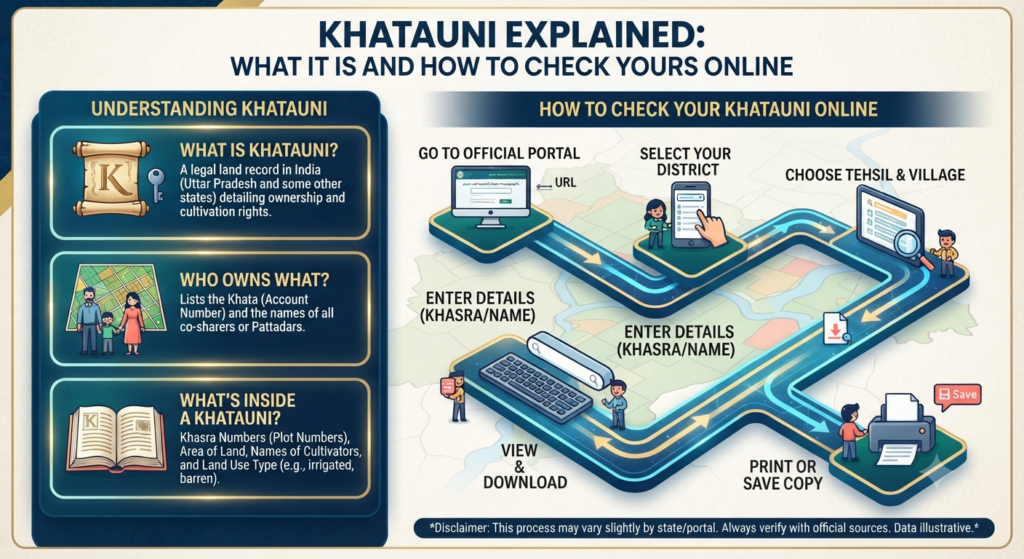
If you are buying agricultural or rural land in North India, one document will come up again and again — the Khatauni. Understanding the Khatauni meaning in land records is essential, because it tells you who holds a piece of land, how much they hold, and in what share. This guide explains what a Khatauni is, how it differs from a Khasra, and how to check and download yours online.
What is a Khatauni?
A Khatauni is a register of land holdings maintained by the revenue department. It is essentially an account statement for a landholder (called a khatedar or khatadar): it lists all the plots that a person or a family owns within a particular village, together with the area of each plot and the share each co-owner holds. The Khatauni is part of the wider Record of Rights (RoR) that the state keeps for every village. It is commonly used in Uttar Pradesh, Uttarakhand, Bihar, Haryana, Madhya Pradesh, Rajasthan and other northern states, though the exact name and format vary from state to state.
Think of it this way: while a village map shows plots on the ground, the Khatauni shows people and what each of them owns. It is grouped by owner rather than by plot, which makes it the go-to document for confirming a person’s total holding in a village.
Difference between Khasra and Khatauni
Buyers often confuse the two. The difference between khasra and khatauni is really about the level of detail:
| Feature | Khasra | Khatauni |
|---|---|---|
| What it records | A single plot of land | All plots held by one owner/family |
| Organised by | Plot (khasra) number | Owner (khata) number |
| Typical details | Area, soil type, crop, current use | Owner names, shares, list of khasra numbers |
| Best used for | Identifying a specific plot | Confirming a person’s total holding |
In short, a Khasra number identifies a plot, while a Khatauni (also linked to a khata or khewat number) groups together every plot an owner holds. You usually need both when verifying land — the Khatauni to see who owns what, and the Khasra to pin down the exact plot. To see a plot’s shape and boundaries on a map, pair these with the Bhu Naksha plot map, and learn to read boundaries with our guide on how to read a cadastral map.
How to check Khatauni online
Most states have digitised land records, so you no longer need to visit the Patwari for a basic copy. The general steps for how to check khatauni online are:
- Open your state’s land records portal (for example, UP Bhulekh in Uttar Pradesh, or Apna Khata / e-Dharti in Rajasthan).
- Select your district, tehsil and village from the drop-down menus.
- Search using the khata number, khasra/gata number, or the owner’s name.
- View the Khatauni details displayed on screen — owner names, shares and the plots listed.
In Uttar Pradesh specifically, our step-by-step Bhulekh UP guide walks through the exact portal screens. Because portal names and steps change, always start from the official state land records website rather than a third-party link.
Khatauni nakal download
The on-screen copy is fine for a quick check, but for records you may want a khatauni nakal download — “nakal” simply means a copy. Most portals let you view and print an unsigned copy for free. A certified Khatauni nakal, which carries legal weight, is usually issued by the Tehsildar or through the state’s certified-copy service, sometimes for a small fee. If your state routes certificates through an e-district system, our overview of the eDistrict portal explains how those certified copies are requested and delivered.
Khatauni as land ownership proof
A common misconception needs clearing up. When people ask about khatauni as land ownership proof, the accurate answer is that it is strong supporting evidence, not conclusive proof of title on its own. The Khatauni records who is in possession and recognised as the holder for revenue purposes, and it is relied upon heavily in land dealings. However, ownership in law is established by the chain of registered documents — the sale deeds, gift deeds or succession records that transferred the land. Always read the Khatauni alongside the registered title deeds and a fresh encumbrance certificate before you pay any money. Relying on the Khatauni alone can hide disputes, mortgages or older ownership claims.
Why the Khatauni matters when buying land
For a buyer, the Khatauni is a first-line verification tool. It confirms whether the seller’s name actually appears against the plot, whether there are multiple co-owners whose consent you need, and the exact share each holds. Mismatches — such as the seller’s name not appearing, or an undisclosed co-owner — are red flags that should be resolved before proceeding. Treat the Khatauni as the starting point of due diligence, followed by the title deeds, encumbrance check and, ideally, a physical survey of boundaries.
Frequently Asked Questions
What is the meaning of Khatauni in land records?
What is the difference between Khasra and Khatauni?
How can I check my Khatauni online?
Is a Khatauni valid proof of land ownership?
How do I download a certified Khatauni nakal?
This article is for general information only and is not legal advice. Land record formats, portal names and procedures differ by state and change over time — verify details on your state’s official land records portal and consult a lawyer before any land transaction. Godrej Realty Homes is a property listings portal.