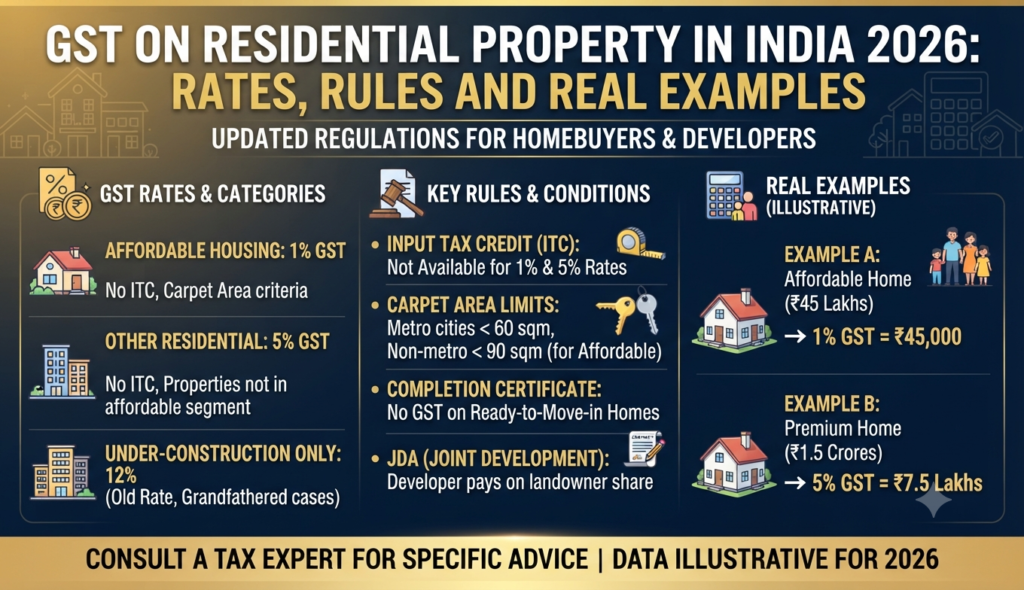
Few things confuse home buyers more than the tax on a flat, so let’s clear it up. GST on residential property in 2026 depends on one thing above all: whether the home is still under construction or already complete. Get that distinction right and the rest — the 1% and 5% rates, the “no input tax credit” rule, and the exemptions — falls neatly into place. This guide explains the rates with worked examples.
The single rule that decides everything
GST is a tax on the supply of goods and services. When a builder is still constructing your flat and sells it to you, that counts as a supply of construction service — so GST applies. Once the building has received its completion certificate (or occupancy certificate) and is ready to move in, selling it is treated as a sale of immovable property, which is outside GST.
In short: under-construction = GST applies; ready-to-move with a completion certificate = no GST. If you are weighing the two, our guide on under-construction vs ready-to-move flats covers the wider trade-offs.
GST rates on residential property in 2026
The rates introduced from 1 April 2019 continue to apply. The catch is that these lower rates come without input tax credit (ITC) — the builder cannot pass on credit for the GST paid on cement, steel and other inputs.
| Type of property | GST rate (2026) | Input Tax Credit |
|---|---|---|
| Affordable under-construction housing | 1% | Not available |
| Non-affordable under-construction housing | 5% | Not available |
| Ready-to-move (completion certificate issued) | Nil | Not applicable |
| Resale property | Nil | Not applicable |
| Plot / land purchase | Nil | Not applicable |
Note that GST is charged on the value of the flat but not on the land component; for apartment sales the law provides a standard one-third deduction of the total value towards land, which is already baked into the effective 1%/5% rates.
What counts as “affordable housing”?
The 1% rate is not automatic — the home must meet the government’s definition of an affordable residential unit. Both conditions below must be satisfied:
- Value: the total consideration does not exceed ₹45 lakh, and
- Carpet area: up to 60 sq. m. (about 645 sq. ft.) in metropolitan cities, or up to 90 sq. m. (about 968 sq. ft.) in non-metro cities.
Both the value and the size cap must be met. A flat priced at ₹42 lakh but larger than the carpet-area limit does not qualify, and neither does a compact flat priced above ₹45 lakh. Because the definition hinges on carpet area, it pays to understand exactly what that means — see RERA carpet area and our explainer on carpet area vs built-up vs super built-up.
How to calculate GST on a flat purchase
The calculation is straightforward once you know the rate. GST is applied to the agreement value of the under-construction flat.
Example 1 — affordable flat
Agreement value: ₹40,00,000; carpet area 55 sq. m. in a metro. This meets both affordable conditions, so GST at 1% = ₹40,000.
Example 2 — non-affordable flat
Agreement value: ₹90,00,000 (under construction). GST at 5% = ₹4,50,000.
Example 3 — ready-to-move flat
Agreement value: ₹90,00,000, but the project already has its completion certificate. GST = Nil. You pay only stamp duty and registration charges.
Remember that GST is separate from stamp duty and registration, which every buyer pays regardless — see, for example, our guides to registration costs in Pune.
Common questions the rate table doesn’t answer
- Is GST applicable on a ready-to-move flat? No, provided the completion or occupancy certificate has been issued before the sale. This is a major reason buyers favour ready homes.
- What about GST on materials? Under the September 2025 “GST 2.0” rationalisation, cement moved from the 28% slab to 18%, which lowers builders’ input costs. But since the 1%/5% property rates already exclude ITC, this does not directly change what you pay as GST on the flat.
- Preferential location and parking charges? Amounts a builder charges for a preferred floor, view or parking are generally taxed at the same rate as the flat when bundled with it.
- Maintenance / society charges? Monthly maintenance above the prescribed threshold can attract GST at 18% separately — this is a recurring charge, not part of the purchase.
Buyer takeaways
- Confirm the project’s status in writing — under construction or completion-certificate issued — before you sign.
- Check whether your flat truly meets both affordable conditions if the builder quotes 1%.
- Ask for a clear break-up of price, GST, stamp duty and registration.
- Verify current rates and definitions on the official GST portal or with your CA before closing, as thresholds can be revised.
Browse verified, RERA-registered residential projects to compare under-construction and ready options with their tax implications.
Frequently Asked Questions
What is the GST rate on residential property in 2026?
Is GST applicable on a ready-to-move flat?
How do I know if my flat qualifies for the 1% affordable rate?
How is GST calculated on an under-construction flat?
Do I pay GST on resale property?
This article is for general information only and not tax advice; GST rates, thresholds and definitions can be revised, so verify current figures on the official GST portal or with a qualified chartered accountant before acting. Godrej Realty Homes is a property listings portal.