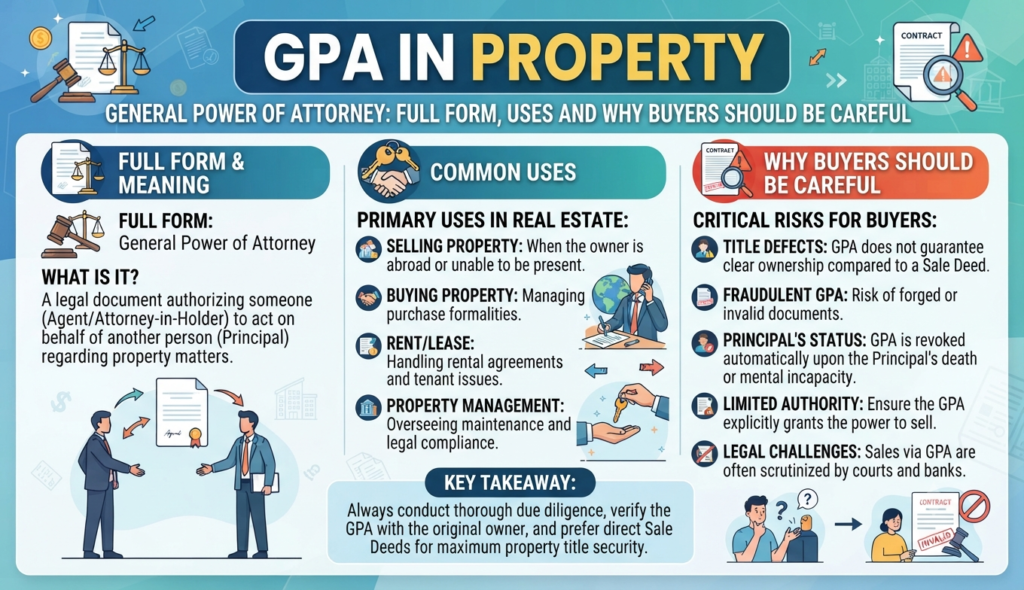
The GPA full form in property is General Power of Attorney — a legal document by which an owner (the principal) authorises another person (the agent or attorney-holder) to act on their behalf. You will often hear of flats or plots being sold “on GPA,” usually at a tempting discount. This guide explains what a GPA really does, why the Supreme Court has ruled it cannot transfer ownership, and the risks every buyer must understand before touching a GPA property.
What does GPA mean in property?
A General Power of Attorney is an agency instrument. It lets the attorney-holder do a range of acts for the owner — manage the property, collect rent, sign documents, appear before authorities, and in some cases execute a sale deed on the owner’s behalf. A GPA does not make the attorney-holder the owner of the property; it only authorises them to act for the real owner. When the purpose is a single, defined act, a Special Power of Attorney (SPA) is used instead of a general one.
The legal position: Suraj Lamp judgment
The defining ruling is Suraj Lamp & Industries Pvt. Ltd. v. State of Haryana (2011). The Supreme Court held that so-called “SA/GPA/WILL” transfers — selling property through a sale agreement, a general power of attorney and a will instead of a registered sale deed — do not convey ownership or title. Key takeaways from the judgment:
- A GPA is not a conveyance and cannot transfer title to immovable property.
- Only a registered sale deed (executed and stamped as required) legally transfers ownership.
- A GPA-based “sale” does not entitle the buyer to mutation in revenue records or to be recognised as the owner.
- The court did clarify that genuine powers of attorney for lawful purposes remain valid — the ruling struck at using GPA as a substitute for a sale deed, not at legitimate agency.
This position has been reaffirmed in later decisions, so the rule stands in 2026: GPA is not ownership.
Difference between GPA and a sale deed
| Aspect | General Power of Attorney | Sale Deed |
|---|---|---|
| Nature | Authorisation to act for the owner (agency) | Conveyance that transfers ownership |
| Transfers title? | No | Yes |
| Stamp duty | Nominal | Full stamp duty on property value |
| Registration | Optional in many states (but should be registered) | Compulsory |
| Can be revoked? | Yes, generally revocable; ends on the principal’s death | No — it is a completed transfer |
| Buyer becomes owner? | No | Yes |
The gap between “nominal stamp duty” and “full stamp duty” is exactly why GPA sales are marketed as cheaper — the buyer skips the duty a proper registered transfer would attract. That saving is the source of the risk, not a bargain.
Is buying a GPA property legal and safe?
Buying a property purely “on GPA” is not safe, because you never become the legal owner. What you hold is a power to act for someone else — a power that can be revoked and that automatically lapses if the principal dies or becomes incapacitated. You will typically face problems with:
- Mutation and records: revenue authorities will not record you as owner on a GPA alone.
- Home loans: most banks refuse loans on GPA-held property because the title is not clean. Even if you have arranged an EMI plan, the property itself may not qualify as collateral.
- Resale: the next buyer, and their lawyer, will raise the same title objection you should be raising now.
Risks of buying a GPA property
The specific dangers of a GPA purchase include:
- No enforceable title: in a dispute, courts may disregard your GPA-based ownership claim.
- Revocation: the owner can cancel the GPA, and it dies with the principal — leaving you with nothing.
- Multiple sales: an unscrupulous owner can execute several GPAs and “sell” the same property more than once.
- Hidden charges: the property may carry loans or disputes that a GPA does not disclose — always pull an encumbrance certificate and check possession via a possession certificate.
- Tax and legal exposure: because no valid transfer occurred, you may face problems with capital gains, stamp authorities and mutation later.
When is a power of attorney genuinely useful?
A GPA has legitimate uses. An NRI or an owner who cannot be physically present can appoint a trusted attorney to sign a registered sale deed on their behalf — here the buyer still gets a proper sale deed and becomes the true owner; the GPA merely lets the agent sign for the seller. A GPA is also fine for managing property, collecting rent, or handling routine paperwork. The problem is only when a GPA is used instead of a sale deed to dodge stamp duty.
How to protect yourself as a buyer
- Insist on a registered sale deed in your name — treat “GPA sale” as a red flag, not a discount.
- Verify the title chain, encumbrance certificate and land record before paying anything.
- If the seller is acting under a GPA, confirm it is registered, still valid, not revoked, and that the principal is alive and competent.
- Have a property lawyer review every document. When in doubt, walk away.
- Prefer clean-title homes from credible developers — browse verified project listings where ownership transfers through a proper registered deed.
Frequently Asked Questions
What is the full form of GPA in property?
Can a GPA holder legally sell property?
Is it safe to buy a property on GPA?
Why do GPA properties sell cheaper?
What is the difference between GPA and a sale deed?
This article is for general information only and is not legal advice. Property laws and their application vary by state and case — consult a qualified property lawyer and verify current rules before acting on any GPA or sale transaction. Godrej Realty Homes is a property listings portal.