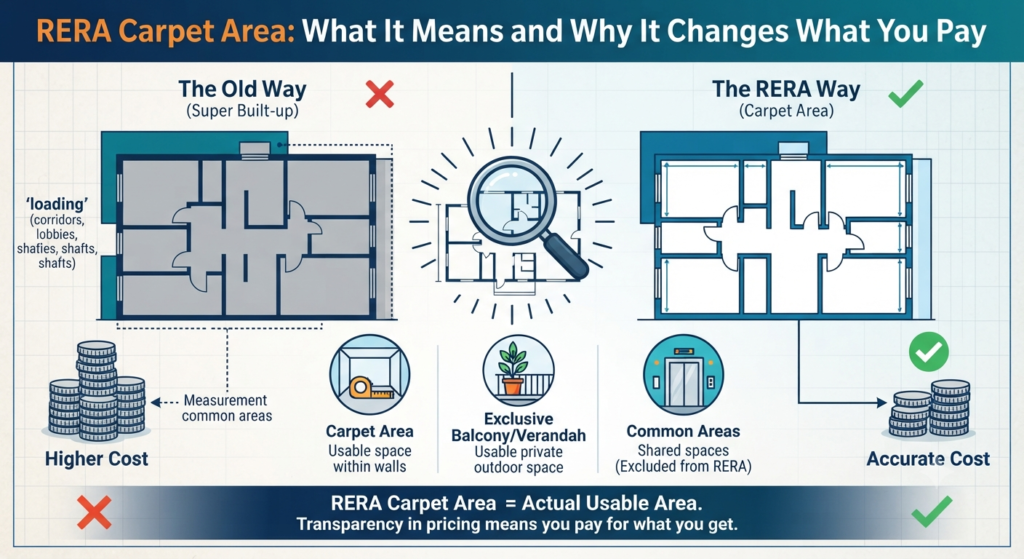
When you buy a flat in India, the number that should matter most is the carpet area — the space you can actually use. The RERA carpet area meaning is a legally defined figure introduced by the Real Estate (Regulation and Development) Act, 2016, and it exists precisely so builders can no longer inflate the size of a home with corridors, shafts, and shared spaces.
This guide explains what RERA carpet area includes and excludes, how it differs from super built-up area, why it changes what you pay, and how to check the carpet area of any registered project.
What is RERA carpet area?
Section 2(k) of the RERA Act defines carpet area as the net usable floor area of an apartment. In plain terms, it is the floor space inside your flat where you could theoretically lay a carpet. The definition specifically:
- Excludes the area covered by external walls, areas under services shafts, and exclusive balcony/verandah and open terrace areas.
- Includes the area covered by the internal partition walls of the apartment.
So RERA carpet area is a little more than the old “usable floor” idea because it counts the internal walls, but it firmly leaves out all the shared and external elements that builders once bundled into the saleable size.
RERA carpet area vs builder super area
Before RERA, builders quoted flats in “super built-up area,” which added a share of common areas — lobbies, staircases, lift wells, clubhouses — to your flat’s actual size. Two projects could apply very different “loading” percentages, making price-per-square-foot comparisons almost meaningless.
| Term | What it covers |
|---|---|
| Carpet area (RERA) | Net usable area inside the flat, including internal walls; excludes external walls, shafts, exclusive balconies |
| Built-up area | Carpet area + external walls + balconies (roughly 10–15% more) |
| Super built-up area | Built-up area + share of common amenities (loading of 25–40% over carpet) |
The gap is significant. A flat sold as 1,000 sq ft super built-up might have a RERA carpet area of only 650–720 sq ft. For a deeper side-by-side breakdown, read our guide to carpet area vs built-up vs super built-up.
Why RERA carpet area changes what you pay
RERA does not ban builders from mentioning super built-up area in marketing, but it requires that the agreement for sale disclose the carpet area and that the price be tied to it. This matters in three ways:
- True price-per-sq-ft: Comparing two projects on carpet area shows what you actually pay for usable space, not marketing spin.
- Delivery accountability: If the delivered carpet area falls short of what the agreement states, the buyer is entitled to a refund (with interest) for the shortfall under RERA rules.
- Honest comparisons: A project with a lower headline rate but a heavier loading can actually be more expensive per usable square foot than a “pricier” one.
Because so much money rides on the figure, always calculate cost on carpet area, and factor in stamp duty and registration — see our state guides such as stamp duty and registration charges in Pune and check whether GST on residential property applies to your purchase.
How to check the RERA carpet area of a project
Every project above the notified size threshold must be registered with the state RERA authority, and the registration includes flat-wise carpet area details. To verify:
- Visit your state’s official RERA website (for example, MahaRERA for Maharashtra, UP RERA, Karnataka RERA).
- Search by the project name, promoter, or RERA registration number.
- Open the project page and review the registered documents, which list the carpet area for each apartment type.
- Cross-check this figure against the number in your draft agreement for sale — they must match.
If the builder’s brochure quotes a much larger size than the RERA-registered carpet area, that is expected — but the sale agreement and price must be based on the carpet area, not the brochure figure.
A quick worked example
Suppose a builder advertises a “1,150 sq ft 2 BHK” and quotes Rs 8,000 per sq ft — a headline price of Rs 92 lakh. If the RERA-registered carpet area is 760 sq ft, your real cost per usable square foot is about Rs 12,100. A neighbouring project quoting Rs 9,000 per sq ft on an 830 sq ft carpet area for the same total could actually give you more usable space for your money. Always run the maths on carpet area before deciding, and use an EMI calculator to see how the final price maps to your monthly outgo.
Frequently Asked Questions
What is RERA carpet area in simple words?
Does RERA carpet area include the balcony?
What is the difference between RERA carpet area and super built-up area?
How can I check a project’s RERA carpet area?
What happens if the delivered carpet area is less than promised?
This article is for general information only. RERA rules and state-level procedures can change, so verify current definitions and project details on your official state RERA portal before acting. Godrej Realty Homes is a property listings portal.