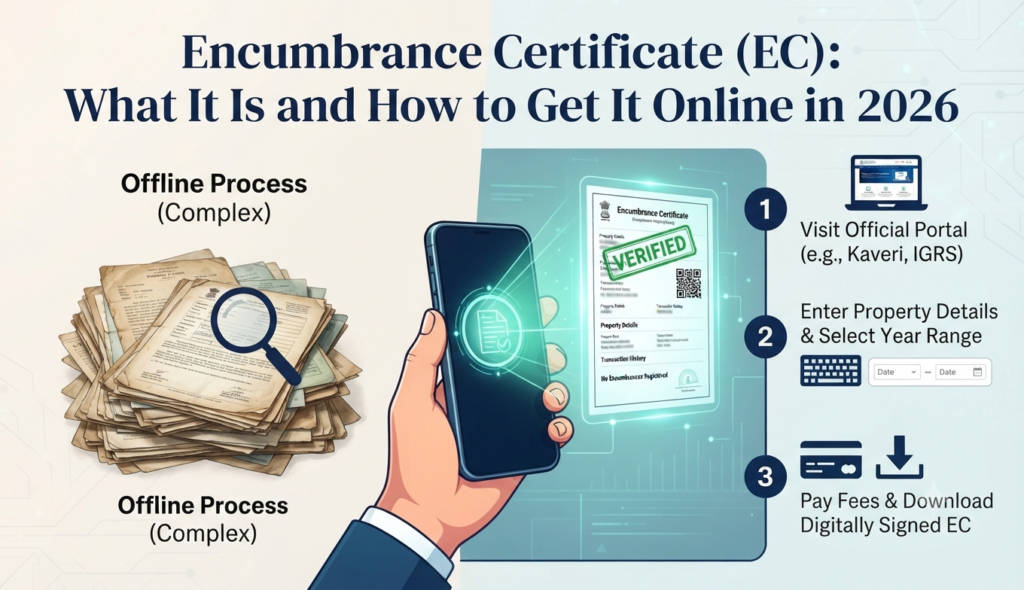
Before you register a property or take a home loan against it, one document decides whether the deal is clean: the encumbrance certificate. Knowing how to get an encumbrance certificate for property registration protects you from buying a flat that still carries a hidden loan or legal charge. This guide explains what an EC is, why banks demand it, and the exact online and offline steps to obtain one in 2026.
What is an encumbrance certificate?
An encumbrance certificate (EC) is an official record from the Sub-Registrar’s office showing all registered transactions on a property over a chosen period — sales, gifts, mortgages, loans and other charges. An “encumbrance” is any liability that limits the owner’s free right to the property. A clean EC (no encumbrances for the searched period) tells a buyer or lender that the property has a clear, marketable title and is not mortgaged or disputed in the records.
In South Indian states the EC often comes in two forms: Form 15 lists transactions when encumbrances exist, while Form 16 (a “nil encumbrance certificate”) is issued when there are none for the requested period.
Why the EC is needed for a home loan and registration
The EC is central to two moments in a property purchase:
- Why the EC is needed for a home loan: Lenders will not sanction a loan until they confirm the property is free of prior mortgages. A clean EC is part of the legal due-diligence file every bank runs before releasing funds, alongside the title deed and approved plan.
- For registration and resale: A buyer uses the EC to verify the seller genuinely owns the property and that no undischarged loan is attached. It is also required for mutation, and sometimes for withdrawing PF for a home purchase.
Pair the EC check with an EMI estimate early, so your budget and your due diligence move together.
What an EC does and does not cover
An EC only reflects documents that were registered at the Sub-Registrar’s office. It will not show unregistered agreements, oral mortgages, tax dues, litigation that never reached the registry, or short-term leases that were not registered. That is why lawyers pair the EC with a title search and, for possession, a separate possession certificate. Treat the EC as a strong signal, not the only check.
How to check an encumbrance certificate online, state by state
Most states now let you check the encumbrance certificate online through their registration portal. The portal name differs by state:
| State | Portal |
|---|---|
| Uttar Pradesh | IGRSUP (igrsup.gov.in) |
| Tamil Nadu | TNREGINET |
| Telangana | IGRS Telangana / Dharani |
| Karnataka | Kaveri Online Services |
| Andhra Pradesh | IGRS AP (Meebhoomi for land records) |
| Gujarat | Garvi (land records via AnyROR) |
Where an online EC is not yet available for older records, you apply in person at the Sub-Registrar office instead.
How to get an encumbrance certificate online: step by step
The process to apply for an encumbrance certificate online is broadly the same across state portals:
- Open your state’s registration/stamps portal and find the “Encumbrance Certificate” or “EC Search” service.
- Register or log in (some states allow a search without login).
- Select the district, Sub-Registrar office, village/area and the property details — survey number, plot/flat number or document number.
- Enter the period you want the search to cover. Buyers usually ask for the last 13–30 years to capture the full ownership chain.
- Pay the search/application fee online.
- Submit and download the EC once generated. In some states the digitally signed EC is issued instantly; in others it is verified by the office first.
You can also download the EC by state as a digitally signed PDF that carries a verification number, so a bank can validate it online.
How to get an EC offline
If the record is old or your state’s online EC does not go back far enough:
- Visit the Sub-Registrar office where the property is registered.
- Fill Form 22 (application for EC) with the property description and the search period.
- Attach ID/address proof and pay the fee (which rises with the number of years searched).
- Collect the EC after processing, typically within a few working days.
Tips before you rely on an EC
- Search a long enough period — a 12–13 year window is a common minimum, but 30 years gives a fuller title chain.
- Cross-check the survey/plot number on the EC against the sale deed and land record; a wrong number returns the wrong property’s history.
- A “nil” EC is reassuring but not absolute — combine it with a title search by a property lawyer.
- If you are early in your search, browse verified project listings and shortlist before commissioning legal checks.
Frequently Asked Questions
How long does it take to get an encumbrance certificate?
What period should the EC cover before buying a property?
Is a nil encumbrance certificate enough to confirm clear title?
Can I get an encumbrance certificate online in every state?
What is the difference between Form 15 and Form 16 EC?
This article is for general information only. Encumbrance certificate procedures, fees and portal features differ by state and change over time — verify the current process on your state’s official registration portal and consult a lawyer before acting. Godrej Realty Homes is a property listings portal.