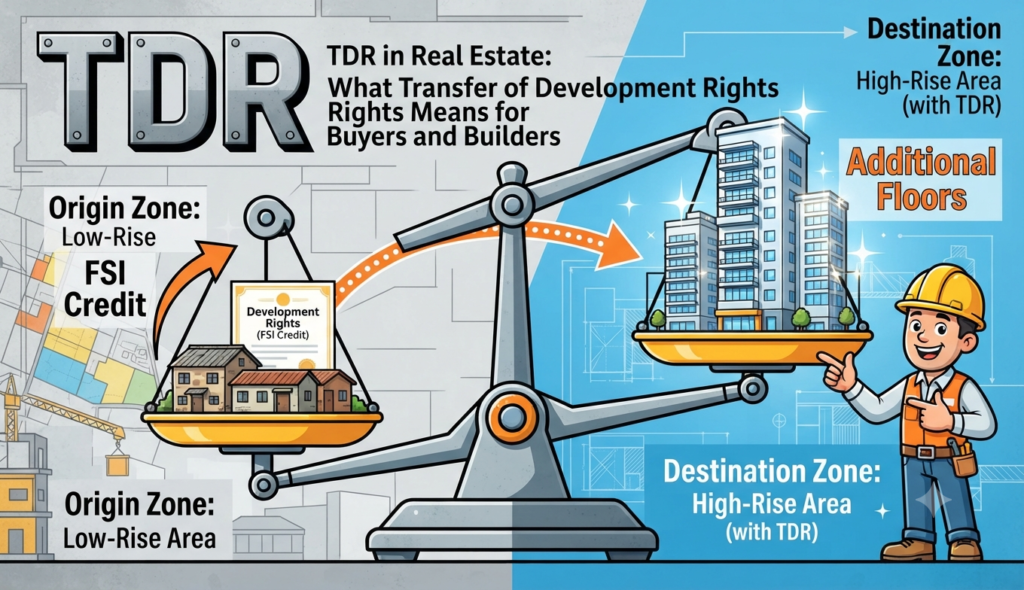
Walk past any road-widening project or a new tower rising taller than its neighbours, and there is a good chance TDR made it possible. The TDR full form in real estate is Transfer (or Transferable) of Development Rights, and it is one of the most powerful — yet least understood — tools in Indian urban planning. This guide explains what TDR is, how it works, and why it matters to both buyers and builders.
What is TDR? The full form and meaning
TDR stands for Transfer of Development Rights, sometimes written as Transferable Development Rights. In simple terms, it is a way of separating a plot’s right to build from the plot itself.
When a landowner gives up part of their land for a public purpose — a wider road, a garden, a school reservation — they usually cannot construct on that surrendered portion. Instead of paying cash, the government compensates them by issuing a certificate that says: “you may build this much additional area somewhere else.” That certificate is the essence of TDR. The owner can use those extra development rights on another plot they own, or sell them to a builder who needs more buildable area.
What is a TDR certificate (DRC)?
The document that carries these rights is officially called a Development Rights Certificate (DRC). Understanding the TDR certificate meaning and value is central to using it:
- It is issued by the local planning authority or municipal corporation to the person who surrendered land or built a public amenity.
- It states the quantum of additional built-up area the holder is entitled to, usually expressed in square metres.
- It is freely transferable — it can be bought, sold or assigned, much like a tradable instrument.
- Its value fluctuates with the local property market and with demand for extra building rights in a given zone.
Because a DRC can be traded, a market of sorts exists where landowners sell TDR and developers buy it to load extra area onto their projects.
How TDR works in construction
To understand how TDR works in construction, it helps to think in terms of two zones defined in the city’s Development Control Regulations (DCR):
| Term | Meaning |
|---|---|
| Generating (sending) plot | The plot from which rights are surrendered — for example, land taken for a road reservation |
| Receiving plot | The plot where the extra rights are actually used to build more area |
| Loading TDR | The act of adding purchased development rights onto a receiving plot to increase its buildable area |
A builder who owns a receiving plot can “load” TDR onto it to construct beyond the base limit that the plot’s normal FSI would allow. This is where TDR ties directly into the Floor Space Index (FSI) — TDR is one of the main routes to legally build extra floor space over and above the base FSI. That is exactly why developers pursue buying TDR for extra FSI in prime locations where every additional square foot is valuable.
Cities set their own rules on how much TDR can be loaded, which zones can receive it, and how it interacts with premium FSI. Receiving plots on wider roads, for instance, are usually allowed to absorb more TDR than those on narrow lanes.
Types of TDR
Most Indian states recognise a few broad categories of TDR, though the exact names vary:
- Road TDR: Granted for land surrendered towards road widening.
- Reserved-plot / amenity TDR: Granted for land handed over for reserved public uses such as gardens, schools or hospitals.
- Slum TDR: Issued to developers who rehabilitate slum dwellers by providing free housing.
- Heritage TDR: Given to owners of heritage structures who cannot fully develop their plots because of conservation restrictions.
Maharashtra — and Mumbai in particular — has one of the most developed TDR markets in the country, which is one reason the concept is so closely associated with Mumbai real estate.
Why TDR matters to homebuyers
You might wonder why a buyer should care about a planning instrument used mainly by developers. There are a few good reasons:
- Legality of the extra floors: If a project is taller or denser than the base FSI would suggest, the additional area should be backed by properly loaded TDR or premium FSI. Ask the developer how the extra area was sanctioned.
- Approved plans: TDR loading must be reflected in the sanctioned building plans. Cross-check that the plan approvals match what is being built.
- Carpet area clarity: More FSI does not automatically mean more usable space for you. Always confirm the carpet area versus super built-up area so you know what you are actually paying for.
- RERA disclosures: Registered projects must disclose sanctioned plans and areas, giving you a paper trail to verify against.
In short, TDR is not something a buyer purchases directly, but understanding it helps you ask the right questions and spot whether a building’s extra bulk rests on a solid legal footing.
Benefits and limitations of TDR
TDR is popular with planners because it lets cities acquire land for public infrastructure without paying large cash compensation, while still fairly rewarding landowners. For developers, it unlocks additional saleable area in land-scarce cities. But it has limits: TDR can usually only be loaded in permitted receiving zones, its market price can be volatile, and mis-selling of unsanctioned area remains a genuine risk. That is why verification against sanctioned plans always matters.
Frequently Asked Questions
What is the full form of TDR in real estate?
Is TDR the same as FSI?
Can an ordinary buyer purchase TDR?
What is a Development Rights Certificate (DRC)?
Which city has the most active TDR market in India?
This article is for general information only and TDR rules, loading limits and zones differ by city and state and change over time. Verify the current provisions with the relevant municipal or planning authority and the project’s sanctioned plans before acting. Godrej Realty Homes is a property listings portal.