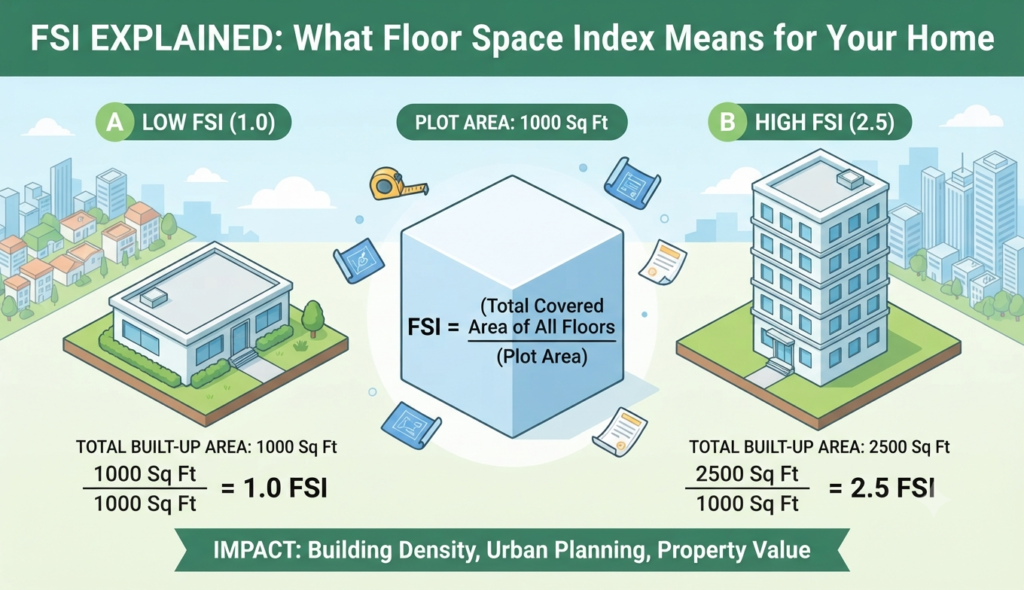
If you have ever wondered why one plot can hold a 20-storey tower while an identical plot next door is capped at four floors, the answer is the FSI. The FSI full form in real estate is Floor Space Index — the single ratio that decides how much you are legally allowed to build on a piece of land. Understanding it helps you judge a project’s density, a plot’s development potential, and whether a builder’s promised carpet area is realistic.
What is FSI (Floor Space Index)?
Floor Space Index is the ratio of the total built-up floor area of a building to the area of the plot it stands on. It is fixed by the local development authority or municipal corporation and is one of the most important numbers in any building by-law. In simple terms, FSI answers the question: “For every square metre of land, how many square metres of construction am I allowed to put up?”
So if a plot has an FSI of 1.5, you can construct built-up area equal to one-and-a-half times the plot size — spread across as many floors as the height rules permit. A higher FSI means denser, taller development; a lower FSI means more open space and lower buildings. Authorities use it to control population density, traffic load, water and power demand, and the overall character of a neighbourhood.
What is FSI in construction — the formula
The calculation is refreshingly simple:
FSI = Total built-up area of all floors ÷ Plot area
Rearranged, the maximum area you can build is:
Permissible built-up area = Plot area × Permissible FSI
Suppose you own a plot of 2,400 sq ft and the sanctioned FSI for your zone is 1.75. The maximum floor area you may construct is 2,400 × 1.75 = 4,200 sq ft. You could build this as a ground-plus-three structure of roughly 1,050 sq ft per floor, or fewer larger floors — as long as the total does not cross 4,200 sq ft and you stay within setback and height limits.
How to calculate FSI for a plot step by step
- Find your plot area in square metres or square feet from the sale deed or survey record.
- Check the sanctioned FSI for your zone and road width from the local development control regulations (DCR).
- Multiply plot area by FSI to get the base permissible built-up area.
- Add any premium FSI, TDR, or fungible FSI you are entitled to buy or load (see below).
- Confirm what is counted and what is excluded — staircases, lift wells, basement parking and some balcony areas are often exempt from FSI.
Because exclusions differ from city to city, always cross-check the definition of “built-up area for FSI purposes” in your local by-laws before finalising a plan.
Permissible FSI in my city — typical ranges
There is no single national FSI. It varies by city, zone, plot size, and the width of the abutting road. The table below shows indicative base ranges for residential plots — treat them as a starting point and verify the exact figure with your local authority.
| City / Authority | Typical residential FSI/FAR | What raises it |
|---|---|---|
| Mumbai (MCGM) | 1.0–1.33 base; effective 2.5–5+ | TDR, fungible & premium FSI |
| Bengaluru (BBMP) | 1.75–3.25 | Wider roads, larger plots, premium FSI |
| Delhi (DDA) | 1.2–3.5 | Smaller plots get higher FAR |
| Pune / PMC | 1.1 base; up to ~4 | Premium FSI, TDR, TOD zones |
| Chennai (CMDA) | 1.5–2.0 | Road width, premium FSI |
Metro-corridor and transit-oriented development (TOD) zones often allow substantially higher FSI to encourage density near stations, which is one reason projects along new metro lines command a premium. If you are comparing homes in a growth corridor, our guide to the best residential areas in South Bengaluru shows how connectivity shapes what gets built.
FSI vs FAR difference
Buyers often ask about the FSI vs FAR difference. In practice they measure exactly the same thing — the ratio of built-up area to plot area. The distinction is only in how the number is expressed. FSI is usually written as a plain decimal (for example 1.5), while FAR (Floor Area Ratio) is sometimes written as a percentage (150%). So a FAR of 150 and an FSI of 1.5 mean an identical allowance. Different states simply prefer different terminology; do not let the label confuse you.
Premium FSI, TDR and how builders get extra floors
Base FSI is not always the ceiling. Cities let developers add area beyond the base allowance through a few mechanisms:
- Premium FSI — extra FSI purchased from the authority by paying a charge linked to road width.
- Transfer of Development Rights (TDR) — development potential moved from one plot (say, land surrendered for a road) and loaded onto another. Read our explainer on TDR in real estate to see how this works.
- Fungible / compensatory FSI — additional area (common in Mumbai) that a developer can convert into saleable space by paying a premium.
This is why the flats on offer in a tower can far exceed what the base FSI alone would suggest. It also explains why the difference between the area you pay for and the area you actually use matters so much — see our comparison of carpet area vs built-up vs super built-up and how RERA carpet area is now the legally defined figure in your agreement.
Why FSI matters to a home buyer
FSI is not just a builder’s concern. A low-FSI project usually means more open space, wider gaps between towers, and better light and ventilation. A high-FSI project packs in more units, which can mean crowding, parking pressure and slower lifts — but often a lower per-square-foot price. Checking the sanctioned FSI and the number of units also tells you whether a project is genuinely low-density as advertised. Before you book, it is worth browsing verified Godrej Properties projects and asking the sales team for the sanctioned plan and FSI utilised.
Frequently Asked Questions
What is the FSI full form in real estate?
How do I calculate the built-up area allowed on my plot?
Is FSI the same as FAR?
What is the permissible FSI in my city?
Does a higher FSI mean a better project?
This article is for general information only and does not constitute legal or construction advice. FSI figures change and vary by locality — verify the current permissible FSI and building by-laws on your municipal or development authority portal before acting. Godrej Realty Homes is a property listings portal.