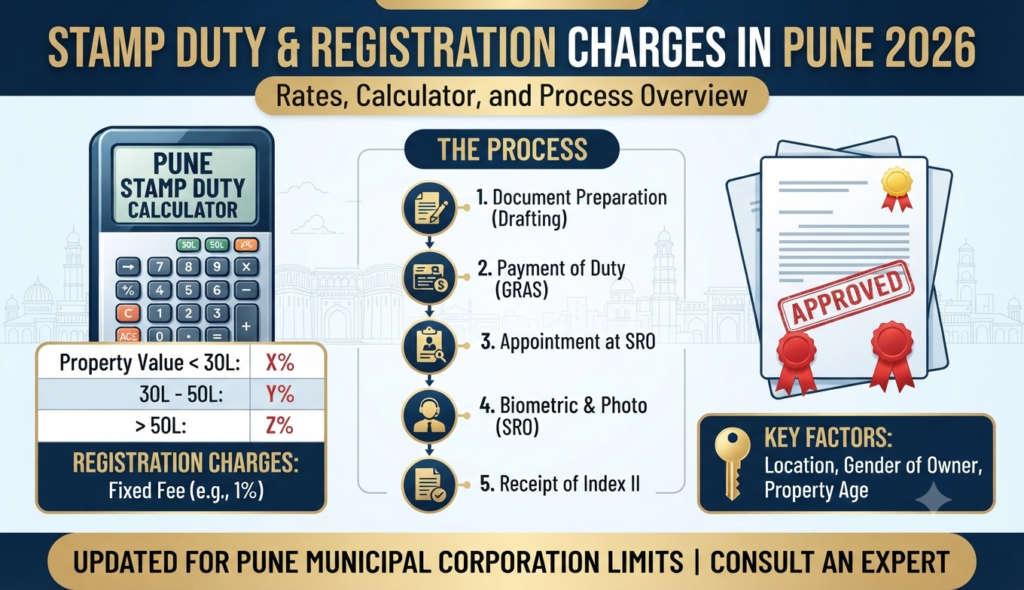
Budgeting for a home in Pune means looking beyond the sticker price. The stamp duty and registration charges in Pune 2026 add roughly 6–7% of your property’s value on top of the cost, and getting them wrong can hold up your registration. This guide lays out the exact rates, the concession for women buyers, how PCMC differs, and the step-by-step online payment process so you can plan the full outgo before you sign.
Stamp duty and registration charges in Pune 2026: the headline rates
Stamp duty in Pune is levied by the Maharashtra government and is made up of a base duty plus two local levies. Within municipal corporation limits (Pune Municipal Corporation), the components are a 5% base stamp duty, a 1% metro cess and a 1% local body tax. Registration charges are separate and capped.
| Buyer | Stamp duty (total) | Registration charge |
|---|---|---|
| Male / joint (male) | 7% | 1% (max ₹30,000) |
| Female (residential) | 6% | 1% (max ₹30,000) |
Women buyers get a 1% concession on residential property registered solely in their name, which is why the female rate is 6% versus 7% for men. The 1% saving is meaningful — on a ₹80 lakh flat it is ₹80,000 kept in your pocket.
How the charges are calculated
Stamp duty and registration are charged on the higher of your agreement value or the government-notified Ready Reckoner (circle) rate for that locality. If you buy below the Ready Reckoner value, duty is still computed on the reckoner rate. Registration charge is 1% of the value, but it is capped at ₹30,000 for properties valued above ₹30 lakh; below that threshold it is simply 1%.
A worked example
Say a man buys a flat in Kothrud with an agreement value of ₹90 lakh, above the Ready Reckoner rate:
- Stamp duty at 7% = ₹6,30,000
- Registration charge = ₹30,000 (capped)
- Total statutory cost = ₹6,60,000
If the same flat were registered in a woman’s name, stamp duty would drop to 6% (₹5,40,000), saving ₹90,000. Always run these numbers before finalising your budget — the difference between a carpet-area and super-built-up quote can also shift your effective per-square-foot cost, which we explain in our guide on carpet area vs built-up vs super built-up.
PCMC property registration charges
Properties within the Pimpri-Chinchwad Municipal Corporation (PCMC) — covering areas like Wakad, Pimple Saudagar, Ravet and Chinchwad — follow the same Maharashtra framework. For PCMC, the effective stamp duty works out to around 6–7% depending on whether the buyer qualifies for the women’s concession, plus the standard 1% registration charge capped at ₹30,000. Because PCMC is a fast-growing corridor, always confirm the current Ready Reckoner rate for the specific node, as they vary widely between older and newly developed pockets.
How to pay stamp duty online in Maharashtra
Maharashtra lets you pay stamp duty and registration fees online through the GRAS (Government Receipt Accounting System) portal, generating an e-challan that the sub-registrar accepts. Here is the typical flow:
- Visit the GRAS portal (gras.mahakosh.gov.in) and select the Inspector General of Registration department.
- Choose “Pay without registration” if you do not have a login, then pick the district (Pune) and the relevant sub-registrar office.
- Select the payment type — stamp duty, registration fee, or both — and enter the property and party details.
- Enter the amount, choose your bank for net banking or card payment, and complete the transaction.
- Download and print the e-challan. Carry it to your booked appointment at the sub-registrar’s office.
After payment, you book a slot for document registration, appear in person with the seller and two witnesses for biometric verification, and collect the registered document. Keep the challan and receipt safe — you will need them for your possession certificate and home-loan disbursal.
Documents you need for registration
- Sale agreement / sale deed drafted on the correct stamp value
- GRAS e-challan proving stamp duty and registration fee payment
- PAN cards and Aadhaar of buyer, seller and two witnesses
- Passport-size photographs of all parties
- Property card / index II and the latest Ready Reckoner extract
- No-objection certificate from the society or builder where applicable
Before registration, it is wise to verify the property’s legal history with an encumbrance certificate so you know it is free of undisclosed loans or disputes.
Tips to plan your Pune home budget
Set aside 7–8% of the property value for stamp duty, registration and incidental legal costs. If your spouse or a woman co-owner can take title, the 1% concession is worth claiming. Factor GST separately for under-construction homes, and confirm the current Ready Reckoner rate for your locality since it directly drives the duty. If you are still shortlisting, explore Godrej projects in Pune to compare locations and price points across the city.
Frequently Asked Questions
What is the stamp duty in Pune in 2026?
Do women pay lower stamp duty in Pune?
What are the registration charges for a flat in Pune?
How do I pay stamp duty online in Maharashtra?
Are PCMC stamp duty charges different from Pune city?
This article is for general information only. Stamp duty rates, cesses and Ready Reckoner values are revised periodically — verify the current figures on the Maharashtra IGR (igrmaharashtra.gov.in) or GRAS portal before you transact. Godrej Realty Homes is a property listings portal.