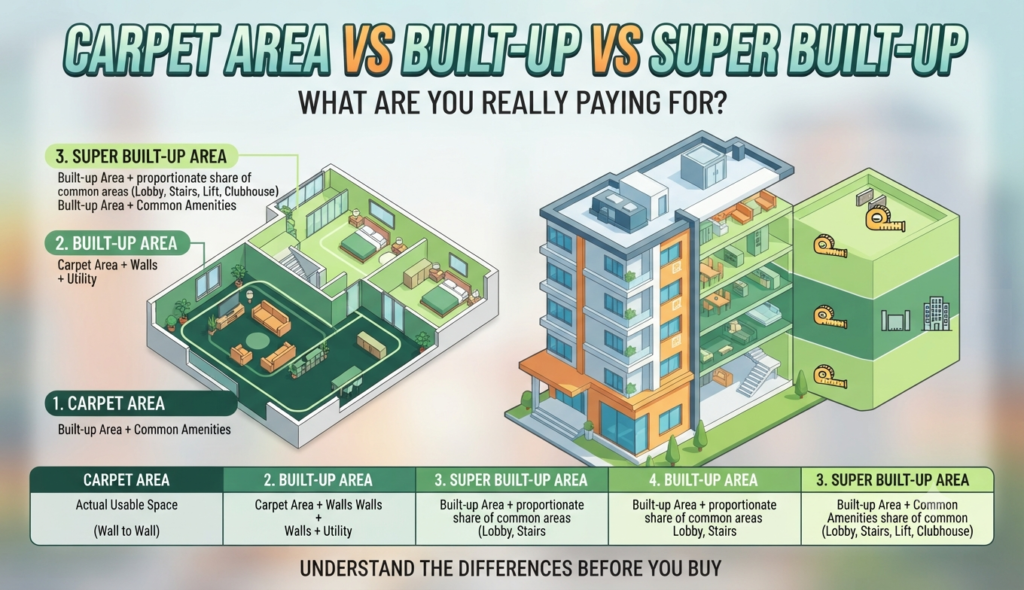
When you compare two flats priced at the same rate per square foot, the one with a smaller carpet area can actually give you less usable home. Understanding carpet area vs super built up area is the single most important skill for judging what you are really paying for, because builders quote price on the largest number while you live inside the smallest one.
The three area definitions, in plain English
Every flat in India is described using three overlapping measurements. They sound similar, but the gap between them decides how much space you actually get to walk on.
- Carpet area — the net usable floor area inside your flat, measured wall to wall, where you can literally lay a carpet. It includes bedrooms, living and dining space, kitchen, bathrooms and internal passages, but excludes the thickness of the outer walls.
- Built-up area — carpet area plus the area occupied by the walls themselves and features like a dry balcony or duct. This is typically 10–15% more than carpet area.
- Super built-up area — built-up area plus your proportionate share of common spaces: lobbies, staircases, lift wells, corridors and sometimes amenities. This is the “saleable area” builders usually advertise.
So the order from smallest to largest is always carpet < built-up < super built-up. You pay on the super built-up figure, but you live within the carpet area.
What is the loading factor in real estate?
The difference between super built-up and carpet area, expressed as a percentage, is called the loading factor. It represents the common-area load added on top of your usable space.
The formula is simple:
Loading factor = (Super built-up area − Carpet area) ÷ Carpet area × 100
If a flat has 1,000 sq ft carpet area and 1,300 sq ft super built-up area, the loading is (1,300 − 1,000) ÷ 1,000 = 30%. A decade ago loading of 25–30% was common; in many premium projects with lavish lobbies and clubhouses it now runs to 35–45%. A lower loading factor means more of what you pay for is inside your walls, so always ask the sales team for it directly.
Usable area vs saleable area in a flat
Two phrases trip up buyers most: usable area and saleable area. Usable area is effectively your carpet area — the space you can furnish and occupy. Saleable area is the super built-up area on which the price is calculated. When a broker says “1,200 sq ft flat” they almost always mean saleable/super built-up, not the roughly 800–850 sq ft you may actually get to use.
This is why two projects quoting the same per-square-foot rate can offer very different real value. A tower with 28% loading gives you noticeably more home than one with 42% loading at the same headline price. Comparing on carpet area vs super built up area — not on the advertised size — is the only apples-to-apples method.
How to calculate carpet area from super built-up
You do not have to trust the brochure. If you know the super built-up area and the loading factor, you can work backwards:
- Ask the developer for the exact loading factor (or derive it from the RERA carpet area disclosed in the agreement).
- Divide the super built-up area by (1 + loading factor). For a 1,300 sq ft super built-up flat with 30% loading: 1,300 ÷ 1.30 = 1,000 sq ft carpet.
- Cross-check against the carpet area printed in the sale agreement and the RERA registration — these are legally binding numbers.
Conversely, to estimate the price you are paying per usable foot, divide the total flat cost by the carpet area rather than the super built-up area. That “effective carpet rate” is the truest measure when you compare projects. If you are also budgeting your loan, run the numbers through a home loan EMI calculator using the all-in cost, not just the base price.
RERA carpet area meaning for buyers
The Real Estate (Regulation and Development) Act, 2016 finally put a legal definition behind the word “carpet.” Under RERA, carpet area is the net usable floor area of the apartment, excluding external walls, service shafts, exclusive balcony or verandah, and open terrace areas — but including internal partition walls. Crucially, developers must now quote and sell on RERA carpet area, and it must appear in the sale agreement.
This protects you in three ways: the number is standardised across builders, it is disclosed on the state RERA website, and the price and possession terms are tied to it. Before booking, verify the figure on your state’s RERA portal and read our detailed guide to RERA carpet area so you know exactly what the developer is legally committing to. It is the single most reliable number in the entire brochure.
A quick comparison table
| Measure | What it includes | Typical size (for an “1,300 sq ft” flat) | What you use it for |
|---|---|---|---|
| Carpet area (RERA) | Net usable floor inside walls | ~1,000 sq ft | Real living space; legal reference |
| Built-up area | Carpet + walls + ducts | ~1,120 sq ft | Understanding construction footprint |
| Super built-up area | Built-up + share of common areas | ~1,300 sq ft | Advertised price basis (saleable) |
Practical tips before you sign
- Always ask for carpet area in writing and confirm it matches the RERA-registered figure.
- Request the loading factor and compare it across shortlisted projects.
- Compute the effective carpet rate to compare true value, especially between an under-construction and a ready-to-move flat where amenities and loading differ.
- Remember that stamp duty and registration charges are usually calculated on the agreement value, so a bigger super built-up figure can raise your closing costs too.
Once you understand these definitions, you can walk into any sales gallery and ask the one question that cuts through the pitch: “What is the RERA carpet area?” Everything else follows from there. Browse verified Godrej residential projects to see how carpet and super built-up areas are disclosed for each configuration.
Frequently Asked Questions
Is carpet area or super built-up area more important when buying a flat?
What is a good loading factor to look for?
Does RERA carpet area include the balcony?
How do I calculate carpet area from super built-up area?
Why do two flats with the same square footage feel different in size?
This article is for general information only and does not constitute legal or financial advice. Area definitions and loading factors vary by project and state; always verify the RERA carpet area and figures in your sale agreement and on the relevant official government portal before acting. Godrej Realty Homes is a property listings portal.