What Is Stamp Duty for Property Registration? A Complete 2026 Guide
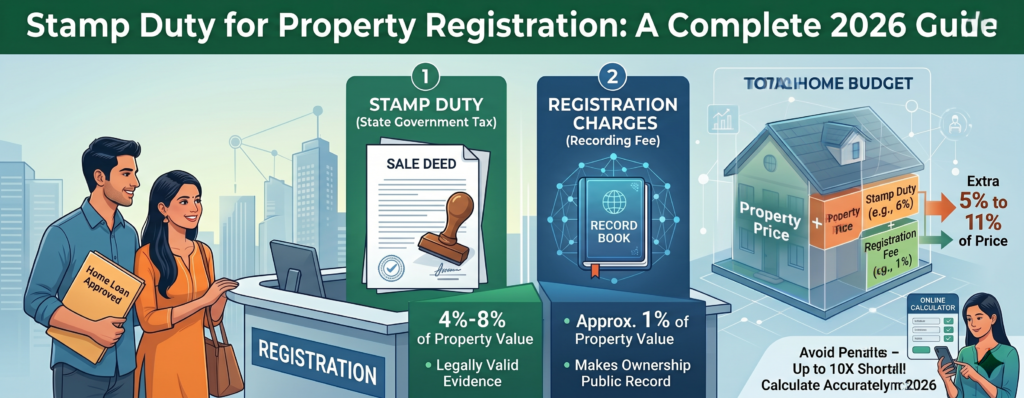
Buying your first home is exciting – until you reach the registration desk and discover two extra charges you may not have budgeted for: stamp duty and registration fees. Together, these can add anywhere from 5% to 11% to your property’s price. So before you sign anything, it pays to understand exactly what stamp duty is, how much you will pay, and how to legally reduce it. This guide explains everything a first-time buyer needs to know about stamp duty for property registration in India in 2026.
What Is Stamp Duty?
Stamp duty is a tax charged by your state government on legal documents – most importantly, the sale deed that transfers a property into your name. Think of it as the government’s official charge for recognising your ownership. Once you pay stamp duty and the document is stamped, your sale deed becomes a legally valid piece of evidence that holds up in court.
Here is the part many buyers miss: an unstamped or under-stamped sale deed has almost no legal value. If a dispute ever arises, a court can refuse to accept it. Worse, paying less stamp duty than required can attract a penalty of up to 10 times the shortfall. Paying the correct stamp duty is not just paperwork – it is what makes your home legally yours.
Stamp Duty and Registration Charges: Understanding the Difference
Buyers often use the phrase “stamp duty and registration charges” as though it were one payment, but they are two separate components.
Stamp duty is the tax on the document itself. Registration charges are the fee paid to the Sub-Registrar’s office for recording your sale deed in the government’s official land records. Registration is what makes your ownership a public record, so anyone verifying the property later sees your name against it.
In most Indian states, stamp duty ranges from 4% to 8% of the property value, while registration charges are usually around 1% (capped in some states). Both are paid together at the time of registration, and in almost every case the buyer pays – not the seller.
What Decides Your Stamp Duty Rates?
Stamp duty rates are not the same for everyone. Several factors decide the final figure you pay:
- State and city: Every state sets its own rates, and urban properties usually attract higher duty than rural ones.
- Gender of the buyer: Many states offer a 1-2% concession when the property is registered in a woman’s name.
- Property type and use: Residential, commercial and agricultural properties are often taxed at different rates.
- Property value: Stamp duty is calculated on the higher of the actual sale price or the government’s circle rate (also called guideline value or ready reckoner rate).
State-Wise Stamp Duty in India 2026
Because stamp duty is a state subject, rates differ widely across the country. The table below gives an indicative state wise stamp duty snapshot for 2026, so you can quickly compare what you would pay in different parts of India.
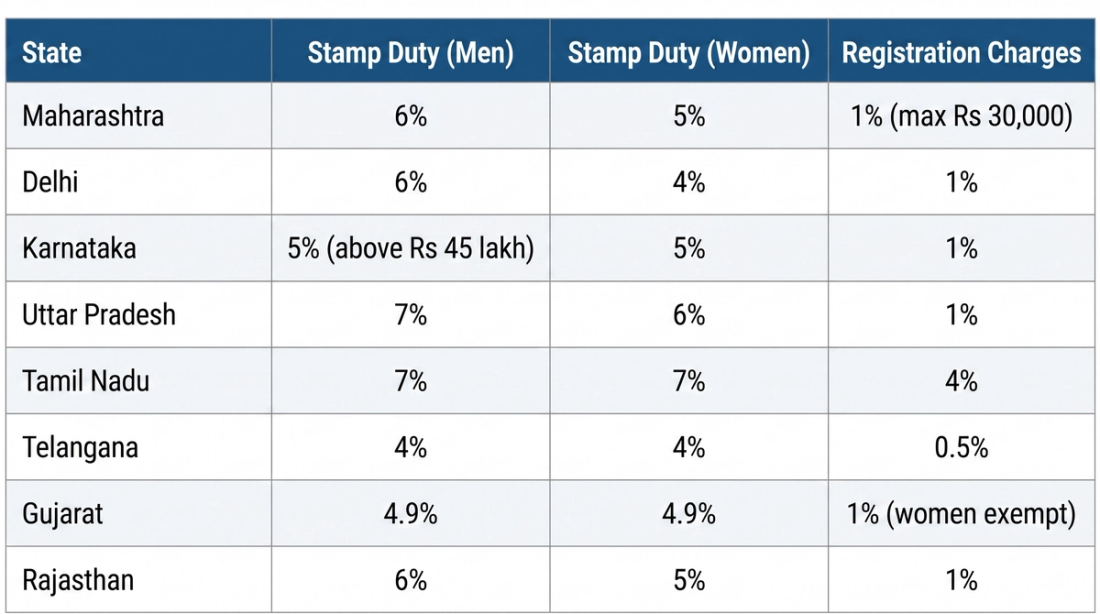
Note: The figures above are indicative for 2026. Karnataka charges 2% up to Rs 20 lakh and 3% between Rs 21-45 lakh. State governments revise stamp duty rates regularly, so always confirm the current rate on your state’s official IGR (Inspector General of Registration) portal before you register.
How to Calculate Stamp Duty and Registration Charges
Calculating stamp duty is simpler than it looks. Just follow these four steps:
- Find the circle rate for your locality on your state’s official registration portal.
- Take the registration value – the higher of the actual sale price and the circle rate.
- Multiply that value by your state’s stamp duty rate.
- Add registration charges, usually 1% of the registration value.
Worked Example – A Flat in Pune for Rs 70 Lakh
If the circle rate is also Rs 70 lakh, a male buyer in Maharashtra (6%) pays stamp duty of Rs 4,20,000. Registration charges at 1% add Rs 70,000 – a total of Rs 4,90,000.
If the same flat is registered in a woman’s name (5%), stamp duty drops to Rs 3,50,000 – a clean saving of Rs 70,000 from a single decision.
How to Pay Stamp Duty Online: E-Stamping Guide
Most states now let you pay stamp duty online, which is faster and far safer than buying physical stamp paper. The common methods are:
- E-stamping via SHCIL: The Stock Holding Corporation of India issues secure e-stamp certificates in many states through its portal and authorised collection centres.
- State IGR portal: States such as Maharashtra, Uttar Pradesh and Telangana allow direct online payment with an instant digital receipt (e-SBTR or GRAS challan).
- Franking: An authorised bank stamps your document after you pay the duty – a method still common in several states.
To pay online, visit your state’s IGR portal or the SHCIL website, select stamp duty payment, enter the property and party details, pay through net banking or UPI, and download the e-stamp certificate. Always use official channels only – fake or insufficient stamp paper is a criminal offence and can invalidate your registration.
How to Save on Stamp Duty and Registration Charges
Stamp duty is a large cost, but first-time buyers can legitimately bring it down. Here are five proven ways:
- Register in a woman’s name: A wife, mother or daughter as the sole or first owner can unlock a 1-2% concession in many states.
- Claim a tax deduction: Under Section 80C of the Income Tax Act, stamp duty and registration charges on a new home can be claimed as a deduction of up to Rs 1.5 lakh, in the financial year of payment (available under the old tax regime).
- Buy where the circle rate is lower: Since duty is based on the higher of price or circle rate, localities with realistic circle rates cost less to register.
- Time your purchase: States occasionally cut stamp duty to revive the housing market – watch for such limited-period windows.
- Use gift deeds within the family: Property transfers between close relatives often attract concessional or nominal stamp duty.
Mistakes First-Time Homebuyers Make
A handful of avoidable errors cost buyers dearly. Steer clear of these:
- Assuming the home loan covers it: Lenders fund the property price, not stamp duty. You must arrange these charges from your own savings.
- Budgeting only for the sticker price: Add 6-11% for stamp duty and registration before deciding what you can truly afford.
- Under-declaring the property value: Registering below the actual price to save duty is illegal and risks heavy penalties.
- Delaying registration: Stamp duty rates can rise; registering promptly locks in the current rate.
Final Word
Stamp duty rates and registration charges change frequently and vary by state, city and buyer profile. Treat the figures in this guide as indicative, and always confirm the current rates on your state’s official IGR portal – or with a property lawyer – before you register your home. A little research here can save you tens of thousands of rupees and protect the biggest purchase of your life.
Frequently Asked Questions
1. What is stamp duty and why do I have to pay it?
What is stamp duty? It is a state government tax on your property’s sale deed. You pay it to make the document legally valid – without it, your ownership cannot be reliably proven in court.
2. How much are stamp duty rates in India?
Stamp duty in India generally ranges from 4% to 8% of the property’s registered value, plus around 1% in registration charges. The exact stamp duty rates depend on your state, your city, and the buyer’s gender.
3. Why is there state wise stamp duty variation?
Stamp duty is a state subject under the Constitution, so each state sets its own rates. This is why state wise stamp duty differs – for example, Telangana charges around 4% while Kerala charges close to 8%.
4. Are stamp duty and registration charges the same thing?
No. Stamp duty is the tax on the sale document, while registration charges are the fee for officially recording it in government land records. They are paid together but are two separate parts of your total cost.
5. Can I get a refund of stamp duty?
Yes, in many states. If a property deal is cancelled before registration, you can usually apply for a stamp duty refund within a set period (often six months), minus a processing fee. Refunds after registration are very difficult to obtain.