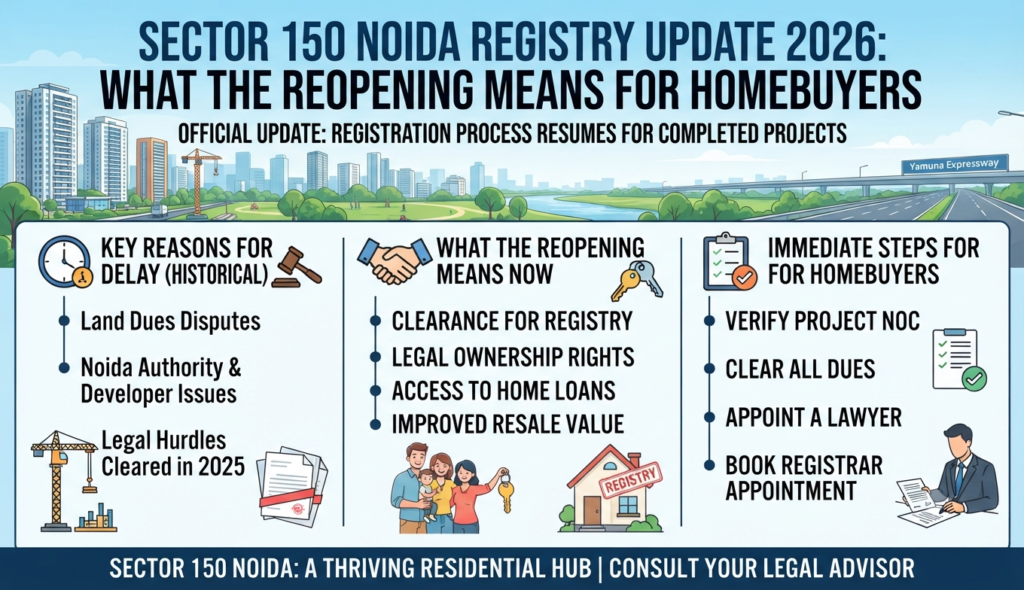
If you own a flat in Sector 150 Noida — or you’ve been eyeing one — you already know the story. For years the keys were in your hand but the paperwork wasn’t. Thousands of families were living in finished apartments they technically didn’t own on paper, because registries in the area were frozen. In 2026 that finally started to change. Here’s a plain-English look at what happened, why, and what it means for you before you head to the sub-registrar’s office.
What is the Sector 150 registry freeze — and what changed in 2026?
Sector 150 sits inside Noida’s ambitious “Sports City” project — a plan where large chunks of land were earmarked for stadiums and academies, with residential towers built alongside. It is one of the greenest, lowest-density pockets in all of Noida, which is exactly why buyers loved it.
The trouble started in January 2021, when the Noida Authority halted registries across the Sports City sectors over unpaid developer dues, disputes about the “sports land” commitments, and later scrutiny of the original land allotments. Homebuyers were caught in the middle — many had paid in full and moved in, but couldn’t get their homes registered in their names. Then, after a Supreme Court directive in late 2025, the Noida Authority took up the matter at its 222nd Board Meeting and conditionally lifted the registry freeze on 6 April 2026, letting registries restart in a controlled, phased way.
Registry-stuck vs registry-ready: what the difference means
The single biggest change is what you can actually do with your home once it is registered. Here is how a stuck unit compares with a registry-ready one:
| What it affects | Registry-stuck home (pre-April 2026) | Registry-ready home (after reopening) |
|---|---|---|
| Legal title | No sale deed; ownership stuck in limbo on paper | Sale deed registered in your name |
| Reselling | Very hard; buyers stay wary | Free to sell with a clean, transferable title |
| Home loan / collateral | Difficult to mortgage or refinance | Can be used as collateral for a loan |
| Typical pricing | Discounted — buyers price in the risk | Roughly 15–20% premium for the clean title |
How to get your Sector 150 flat registered: step by step
Once your project qualifies under the new framework, the registration itself follows a familiar path. Here is the typical sequence:
- Confirm your tower has its occupancy certificate (OC) and is cleared for registration.
- Check that your developer has deposited the required 20% of dues and met the Authority’s conditions for your project.
- Verify the current circle rate for Sector 150 and your specific project.
- Calculate stamp duty on the higher of the circle rate or your agreement value (see the rates below).
- Decide the ownership structure — a female or joint registration lowers your stamp duty.
- Book an appointment at the sub-registrar’s office with your allotment letter, builder-buyer agreement and payment records.
- Complete the registration and collect your registered sale deed — your legal proof of ownership.
Stamp duty, registration and circle rates in 2026
Getting a registry done isn’t free, so budget for it. Stamp duty is charged on whichever is higher — your agreement value or the government’s notified circle rate. Noida revised circle rates upward by about 3.58% in 2026, and Sector 150 sits in the developing-sectors band, where residential rates run in the region of ₹41,500–₹47,500 per square metre (confirm the exact current figure for your project). Here is what the charges look like:
| Buyer | Stamp duty | Registration | On a ₹1 crore home |
|---|---|---|---|
| Male | 7% | 1% | ₹8 lakh |
| Female | 6% | 1% | ₹7 lakh |
| Joint (male + female) | 6.5% | 1% | ₹7.5 lakh |
The 1% break for women can save up to about ₹1 lakh on properties valued up to ₹1 crore, so registering in a woman’s name (or jointly) is one of the simplest ways to trim the bill.
A quick checklist before you register
- Confirm the tower’s occupancy certificate and registration clearance.
- Verify the developer has met the Authority’s payment conditions for your project.
- Check the current Sector 150 circle rate and base your stamp-duty maths on the higher value.
- Choose an ownership structure that works for you — and your stamp duty.
- Keep your payment records, allotment letter and builder-buyer agreement handy, and consider a quick title check from a property lawyer.
Why the Sector 150 registry update matters for home buyers
The 2026 registry update is one of the most positive developments Sector 150 has seen in years. For existing owners, it is the route to finally holding a clean title — the document that lets you sell, mortgage and settle with confidence. For buyers and investors, legal clarity tends to revive demand, and registry-ready homes already command a noticeable premium over stuck ones. The rollout is phased, so some towers will clear faster than others, but the direction of travel is clear. Importantly, the Supreme Court has directed that homebuyers’ rights stay protected even as investigations into the old land deals continue — a meaningful safety net for end-users.
If you’re weighing a home in the Noida–Greater Noida belt, track which towers are becoming registry-ready, watch circle-rate notifications, and factor registration costs into your budget from day one. You can also explore Godrej projects across the region as you compare options.
Frequently Asked Questions
Is property registry open in Sector 150 Noida in 2026?
Why was the Sector 150 registry stopped in the first place?
What conditions did the Noida Authority set to restart registries?
How much are stamp duty and registration charges in Noida in 2026?
Are homebuyers protected despite the ongoing investigations?
Will property prices in Sector 150 rise now that registries have reopened?
This article is for general information only and reflects rules, rates and figures reported as of mid-2026. Registry conditions, circle rates and stamp-duty slabs change over time — please verify current details with the Noida Authority, the sub-registrar’s office, or a qualified property advisor before acting. Godrej Realty (godrejrealty.homes) is an independent property information and listing portal; all trademarks and project details belong to their respective owners.