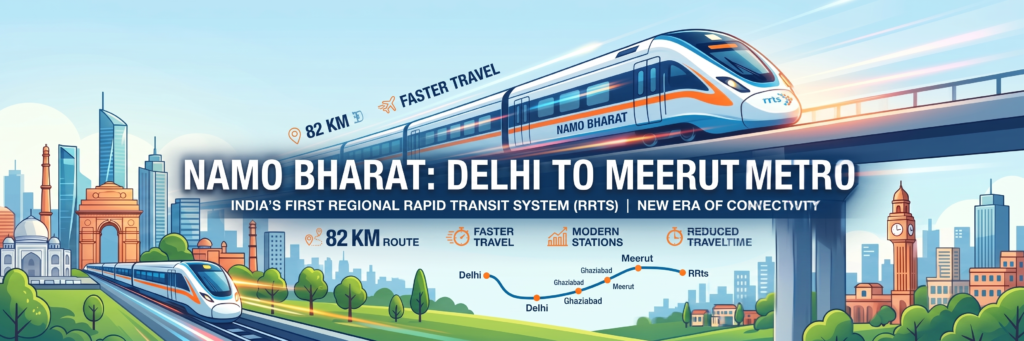
For decades, the Delhi-to-Meerut commute meant bumper-to-bumper traffic on NH-9 and a 90-kilometre drive that could swallow three hours of your day. That story officially changed on 22 February 2026, when Prime Minister Narendra Modi dedicated the full 82-kilometre Namo Bharat Delhi to Meerut Metro corridor to the nation. India’s first Regional Rapid Transit System (RRTS) is now end-to-end operational, and it is already reshaping how millions move between Delhi, Ghaziabad and Meerut.
Here is a clear, updated guide to everything that matters about the Delhi to Meerut RRTS in 2026.
What Is the Namo Bharat Delhi to Meerut Metro?
The Namo Bharat Delhi to Meerut Metro is technically a semi-high-speed regional rail service, not a conventional metro. Built and run by the National Capital Region Transport Corporation (NCRTC), it is engineered for speeds of up to 180 kmph, with an operational top speed of 160 kmph and an average run of around 90 kmph including stops.
Unlike Delhi Metro, the Namo Bharat RRTS skips dense halting and prioritises longer-distance commuting between NCR hubs. Six-coach trains arrive every 10 minutes, services run daily from 6:00 AM to 10:00 PM, and each train offers a standard coach plus a premium coach with reclining seats, more legroom and onboard Wi-Fi.
Full Delhi to Meerut RRTS Route and All 16 Stations
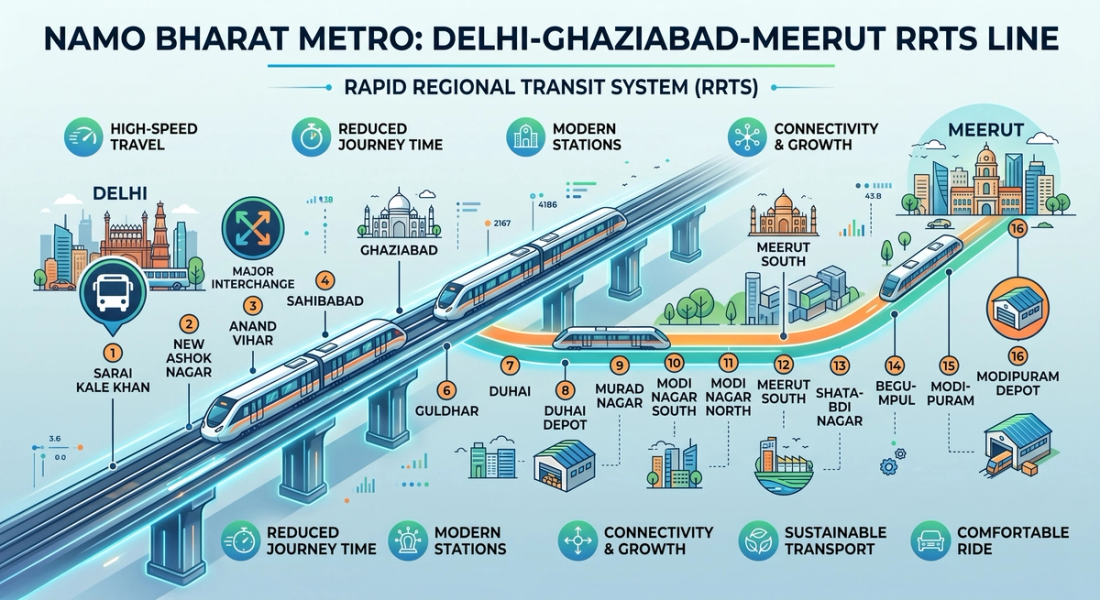
The Delhi Meerut metro route stretches 82.15 km from Sarai Kale Khan in Delhi to Modipuram in Meerut, passing through 16 stations in total:
- Sarai Kale Khan
- New Ashok Nagar
- Anand Vihar
- Sahibabad
- Ghaziabad
- Guldhar
- Duhai
- Duhai Depot
- Murad Nagar
- Modi Nagar South
- Modi Nagar North
- Meerut South
- Shatabdi Nagar
- Begumpul
- Modipuram
- Modipuram Depot
Inside Meerut, several of these stations also double up as part of the Meerut Metro local service, allowing seamless transfer between the regional RRTS and intra-city trips—a first-of-its-kind hybrid model in India.
Namo Bharat Delhi to Meerut Metro Travel Time
This is where the Namo Bharat Delhi to Meerut Metro really pulls ahead. End-to-end travel from Sarai Kale Khan to Modipuram now takes just about 45 minutes, against a road journey that routinely stretches to 2-3 hours in peak traffic. Shorter hops are even more attractive: Sarai Kale Khan to Ghaziabad takes roughly 18-20 minutes, and Anand Vihar to Meerut South is a 35-minute ride.
For working professionals, this effectively brings Meerut within a comfortable daily commuting radius of central Delhi for the first time.
Delhi to Meerut Metro Ticket Price: Standard vs Premium
Affordability is a big part of why the Delhi to Meerut RRTS is winning early ridership. Fares are distance-based and split across two coach types.
Standard coach fares range from Rs 20 for the shortest hop to Rs 150 from New Ashok Nagar to Meerut South, and Rs 210 for the full Sarai Kale Khan to Modipuram ride. Premium coach fares run roughly 20% higher, from Rs 30 at the lower end up to Rs 225 for the full corridor. Premium passengers also get access to dedicated lounges at select stations.
Children under 90 cm in height travel free, and women, senior citizens and Divyangjan passengers get reserved seating in every train.
How to Book Tickets for the Namo Bharat Delhi to Meerut Metro
NCRTC has built the booking experience to be friction-free for both tech-savvy commuters and first-timers. You can buy tickets in four ways: the Namo Bharat Connect app (UPI, cards, wallets), ticket vending machines at every station, manual counters, and the National Common Mobility Card (NCMC) which works as a tap-and-go smart card across India’s metros. QR-code tickets are valid for 60 minutes from the time of purchase.
Real Estate Boom Along the Delhi to Meerut RRTS Corridor
The Namo Bharat Delhi to Meerut Metro is doing more than moving passengers, it is rewriting NCR’s property map. Industry data from early 2026 shows residential prices in Meerut have climbed nearly 50% since corridor construction began, with Modipuram and Pallavpuram projected to see another 30-40% appreciation as feeder infrastructure matures. In Ghaziabad, premium launches near Sahibabad and Vaishali are crossing the Rs 3 crore mark, a band the city rarely touched before.
Built at a cost of more than Rs 30,000 crore, the corridor is now anchoring transit-oriented, mixed-use development around stations such as Duhai, Modi Nagar, Meerut South and Modipuram, making them some of the most attractive entry points for investors in NCR today.
Why the Namo Bharat Delhi to Meerut Metro Matters for NCR
NCRTC projects daily ridership will touch around 1.67 lakh passengers within the first full year of operations, easing pressure on NH-9 and the Delhi-Meerut Expressway. The service is integrated with Delhi Metro at Sarai Kale Khan, Anand Vihar and New Ashok Nagar, and with Indian Railways at three interchange points. The same template is now being extended to the Delhi-Alwar and Delhi-Panipat corridors.
Frequently Asked Questions
Is the Namo Bharat Delhi to Meerut Metro fully operational in 2026?
Yes. The complete 82.15 km Delhi to Meerut RRTS corridor, from Sarai Kale Khan to Modipuram, was inaugurated on 22 February 2026 and now runs across all 16 stations.
What is the Delhi to Meerut metro ticket price for the full route?
The Namo Bharat ticket price for the full Sarai Kale Khan to Modipuram journey is Rs 210 in the standard coach and Rs 225 in the premium coach. Shorter trips start at just Rs 20.
How long does the Namo Bharat Delhi to Meerut Metro take end to end?
Top-to-bottom travel time on the Delhi to Meerut RRTS is approximately 45 minutes, compared with 2-3 hours by road during peak hours.
What are the operating hours and frequency of the Delhi to Meerut Namo Bharat trains?
Namo Bharat services run daily from 6:00 AM to 10:00 PM, with six-coach trains every 10 minutes throughout the day.
Which areas along the Delhi to Meerut metro route are best for real estate investment?
Investor interest in 2026 is strongest around Sahibabad, Duhai, Modi Nagar, Meerut South, Shatabdi Nagar, Modipuram and Pallavpuram, where transit-oriented development and price appreciation along the Namo Bharat corridor are expected to continue.