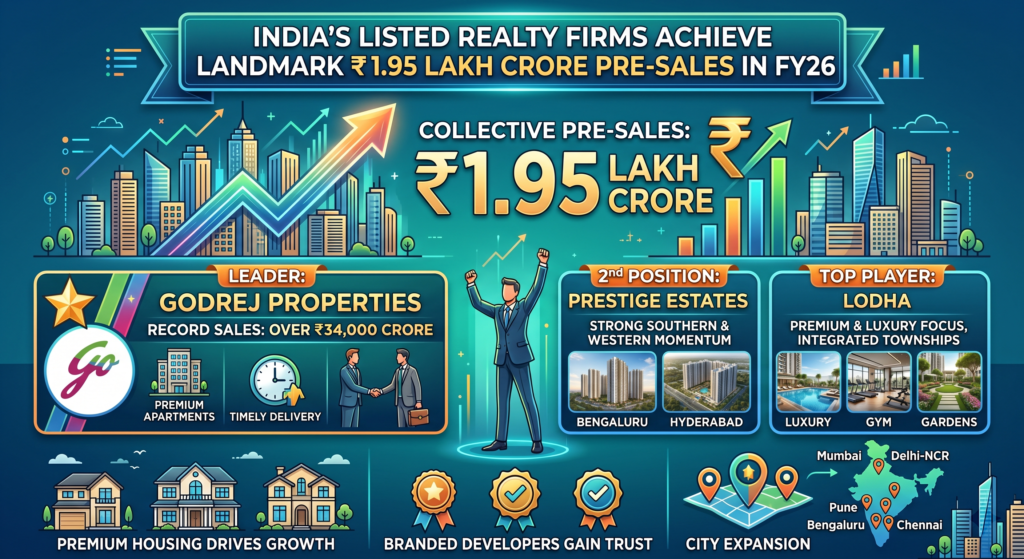
India’s 28 leading listed real estate developers recorded combined pre-sales of nearly ₹1.95 lakh crore in FY26, marking a 17% year-on-year growth. Godrej Properties emerged as the highest-selling developer, followed by Prestige Estates and Lodha Developers, highlighting continued demand for branded residential projects across major Indian cities.
Godrej Properties Retains Leadership Position
Godrej Properties once again emerged as the highest-selling listed real estate company in India during FY26. The developer reported record sales bookings exceeding ₹34,000 crore, reinforcing its position as one of the country’s most trusted residential brands. Strong demand across multiple cities, combined with an aggressive launch pipeline, played a significant role in driving its performance.
The company’s strategy of expanding beyond its traditional markets has also contributed to its growth. Over the last few years, Godrej Properties has strengthened its presence in high-demand urban centres where premium and mid-premium housing continue to attract buyers.
Industry experts believe that the company’s ability to identify emerging residential hotspots and launch projects aligned with consumer preferences has helped it consistently outperform peers.
Prestige Estates and Lodha Strengthen Their Market Presence
Bengaluru-based Prestige Estates Projects secured the second position among listed developers, demonstrating strong momentum across southern and western India. The company benefited from successful project launches in Bengaluru, Hyderabad, and Mumbai while expanding its footprint beyond its traditional home market.
Meanwhile, Lodha Developers maintained its strong standing among India’s top-selling developers. The company’s focus on premium housing, luxury residences, and integrated townships has continued to resonate with homebuyers seeking larger living spaces and modern amenities.
Together, the top developers accounted for a substantial portion of overall industry sales, highlighting the ongoing consolidation within the real estate sector.
Premium Housing Continues to Drive Growth
One of the biggest trends shaping FY26 was the sustained demand for premium and luxury residential properties. Buyers increasingly preferred larger homes, gated communities, and projects offering lifestyle-focused amenities.
Real estate consultants have noted that developers with a higher exposure to premium housing segments recorded stronger sales growth than those focused solely on affordable housing. Rising disposable incomes, improving urban infrastructure, and changing lifestyle preferences have all contributed to this shift.
The demand was particularly strong in metropolitan regions where buyers viewed residential property not only as a place to live but also as a long-term investment asset.
Branded Developers Continue to Gain Market Share
The FY26 performance further reinforces a trend that has been visible since the pandemic: homebuyers increasingly favour organised and branded developers.
Concerns around project delays and execution risks have encouraged buyers to choose developers with strong balance sheets, transparent governance, and established reputations. This preference has enabled leading listed companies to capture a larger share of residential sales across India.
As a result, many mid-sized and regional players have struggled to match the scale and market reach of larger developers.
Industry observers believe this consolidation trend is likely to continue over the next few years as buyers remain selective and financing conditions become more stringent.
Expansion Across Multiple Cities Fuels Sales Momentum
Another important factor behind the record pre-sales figures was geographical diversification.
Many leading developers are no longer dependent on a single city or region for growth. Instead, they have expanded into multiple high-growth residential markets, reducing concentration risks while unlocking new revenue opportunities.
This strategy has allowed companies to benefit from varied demand cycles across different cities. While Mumbai and NCR remain dominant markets, Bengaluru, Hyderabad, Pune, and Chennai have also emerged as significant contributors to overall sales.
The trend is expected to intensify as developers continue acquiring land parcels and launching projects in growth corridors across India.
What This Means for the Indian Real Estate Sector
The record ₹1.95 lakh crore pre-sales figure sends a strong signal about the resilience of India’s residential real estate market. Despite affordability concerns and rising input costs, housing demand remains healthy, supported by urbanisation, income growth, and improving consumer confidence.
The sector’s performance also highlights the increasing maturity of India’s real estate industry. Organised developers are becoming larger, more financially disciplined, and better positioned to execute large-scale projects.
Looking ahead, industry participants expect demand to remain stable, particularly in the mid-income, premium, and luxury segments. New launches, infrastructure-led growth, and continued urban migration are likely to provide additional momentum in FY27.
Conclusion
India’s leading listed real estate companies have delivered a record-breaking performance in FY26, achieving nearly ₹1.95 lakh crore in combined pre-sales. With Godrej Properties retaining the top position and developers such as Prestige Estates and Lodha continuing their strong growth trajectory, the sector has demonstrated remarkable resilience amid evolving market conditions.
As buyer preference increasingly shifts toward trusted brands and premium housing, India’s organised real estate sector appears well-positioned to sustain its growth momentum in the coming years.