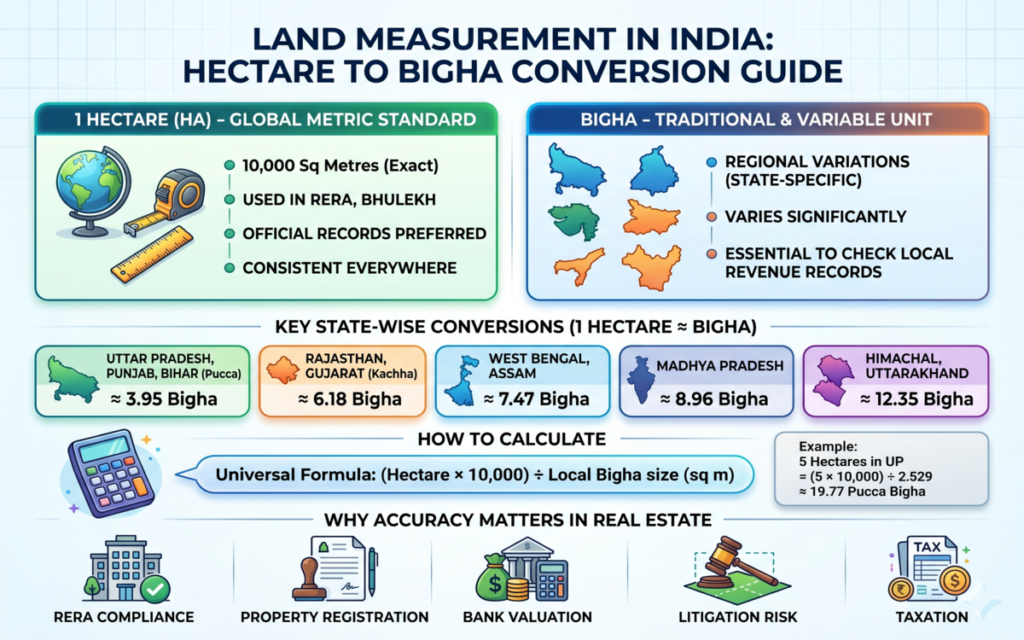
If you are buying agricultural land in Uttar Pradesh, registering a plot in Rajasthan, or reviewing a RERA filing in West Bengal, you will almost certainly encounter two very different units on the same document: the metric Hectare and the traditional Bigha. Confusing the two is one of the most common and most expensive mistakes in Indian real estate. Unlike a square metre or an acre, a Bigha does not have a single fixed value across the country. Its size shifts dramatically from state to state, and even from district to district within the same state.
This comprehensive Hectare to Bigha conversion guide gives you the exact mathematical formula, a verified state-wise conversion table, worked examples for large land parcels, and the regulatory context every buyer, seller, and investor should understand before signing a sale deed.
Understanding the Units (Hectares and Bighas)
Before performing any Hectare to Bigha conversion, it is essential to understand what each unit actually represents in Indian land measurement.
What is a Hectare?
A Hectare (ha) is a standardised metric unit of area used worldwide and accepted in all official Indian land records, including the Bhulekh portal, RERA filings, and revenue department documentation.
- 1 Hectare = 10,000 square metres (exact)
- 1 Hectare = 2.47105 acres
- 1 Hectare = 100 ares
- 1 Hectare ≈ 11,959.9 square yards
Because it is metric and globally consistent, the Hectare is the preferred unit for institutional buyers, infrastructure developers, and government land acquisition records.
What is a Bigha?
A Bigha is a traditional South Asian land measurement unit, but it is not standardised. The Bigha used by a farmer in Punjab is mathematically different from one used in Gujarat or Assam. Broadly, India recognises two informal categories:
- Pucca Bigha (large): Common in Uttar Pradesh, Punjab, Haryana, and Bihar. Roughly 2,529 sq m.
- Kachha Bigha (small): Common in parts of Rajasthan, Himachal Pradesh, and Uttarakhand. Roughly 800–1,620 sq m.
This regional variation is exactly why a single national formula does not exist and why state-wise bigha conversion matters.
State-Wise Hectare to Bigha Conversion Table
The table below provides the most widely accepted land measurement in India values used by revenue departments and property registrars across various states.
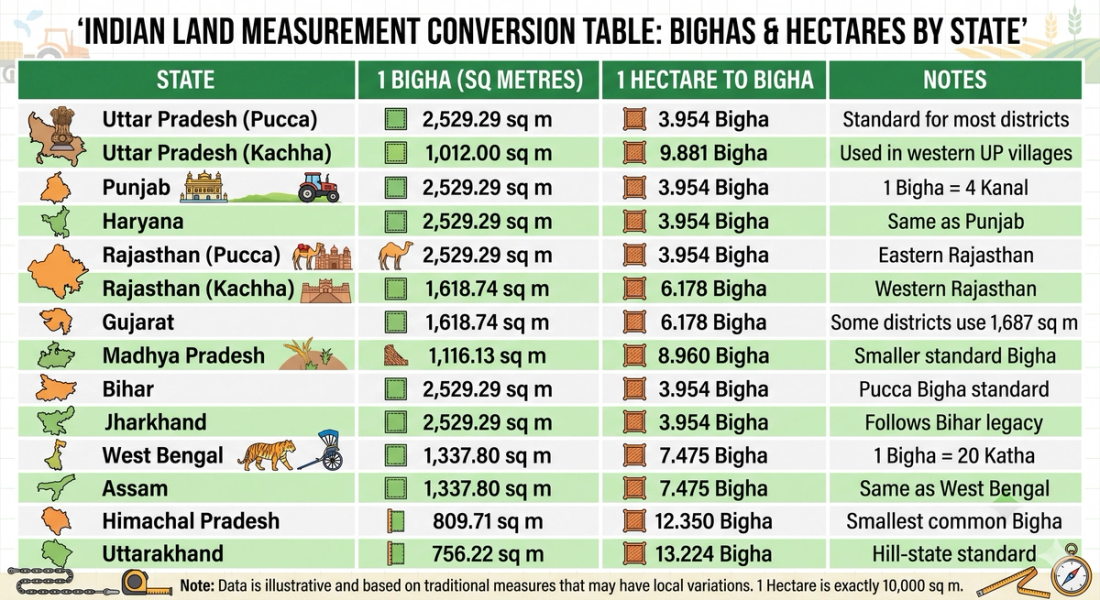
Quick Reference – Popular Hectare to Bigha Conversion Values
- 1 hectare to bigha (UP/Punjab/Haryana/Bihar): ≈ 3.95 Bigha
- 1 hectare to bigha (Rajasthan Kachha/Gujarat): ≈ 6.18 Bigha
- 1 hectare to bigha (West Bengal/Assam): ≈ 7.47 Bigha
- 1 hectare to bigha (Madhya Pradesh): ≈ 8.96 Bigha
- 1 hectare to bigha (Himachal/Uttarakhand): ≈ 12.35–13.22 Bigha
How to Calculate Hectare to Bigha (Formulas & Examples)
The mathematics behind every Hectare to Bigha conversion is straightforward once you fix the state-specific Bigha value in square metres.
Universal Formula:
Bigha = (Hectare × 10,000) ÷ Local Bigha size in sq metres
Worked Example 1: A 5-Hectare Farm in Uttar Pradesh (Pucca Bigha)
- Total area = 5 × 10,000 = 50,000 sq m
- Local Bigha = 2,529.29 sq m
- Bigha = 50,000 ÷ 2,529.29 = 19.77 Bigha
So a 5-hectare agricultural parcel in UP equals roughly 19.77 Pucca Bigha.
Worked Example 2: A 2.5-Hectare Plot in West Bengal
- Total area = 2.5 × 10,000 = 25,000 sq m
- Local Bigha = 1,337.80 sq m
- Bigha = 25,000 ÷ 1,337.80 = 18.69 Bigha
Worked Example 3: A 10-Hectare Industrial Site in Gujarat
- Total area = 10 × 10,000 = 100,000 sq m
- Local Bigha = 1,618.74 sq m
- Bigha = 100,000 ÷ 1,618.74 = 61.78 Bigha
These examples show why a blanket conversion factor is dangerous: the same hectare value translates to 19.77, 18.69, or 61.78 Bigha depending purely on the state.
Why Land Measurement Accuracy Matters in Real Estate
Standardising land records to Hectares rather than relying solely on Bighas has become a regulatory priority for several reasons.
- RERA Compliance: The Real Estate (Regulation and Development) Act, 2016, requires developers to declare project area in square metres or hectares. Sale deeds quoted only in Bighas without metric conversion can trigger registration delays.
- Property Registration: State sub-registrar offices increasingly demand dual measurement on Form 7/12 extracts and sale deeds. A wrong conversion can inflate or deflate stamp duty calculations significantly.
- Bank Valuation & Home Loans: Lenders use metric units for collateral valuation. A 10% mismatch between recorded Bighas and actual hectares can stall loan disbursement.
- Litigation Risk: Inter-state buyers often assume their home state’s Bigha applies elsewhere. This single assumption is responsible for thousands of boundary and title disputes in district civil courts each year.
- GST and Capital Gains: Tax computation on land sales is anchored to metric area. Inaccurate conversion can directly impact tax liability.
For these reasons, every serious investor should treat land measurement in India not as folklore arithmetic but as a precise regulatory exercise — ideally verified against the local Patwari or Tehsildar record.
Frequently Asked Questions
Q1. What is the standard value of 1 Hectare to Bigha in India?
There is no single national value. In most Pucca Bigha states such as Uttar Pradesh, Punjab, Haryana, and Bihar, 1 Hectare equals approximately 3.95 Bigha. In smaller-Bigha states like Himachal Pradesh, 1 Hectare can equal up to 12.35 Bigha.
Q2. How do I calculate Hectare to Bigha conversion for my plot?
Multiply your hectare value by 10,000 to get square metres, then divide by your state’s official Bigha size in square metres. For example, a 1-hectare plot in West Bengal equals 10,000 ÷ 1,337.80 = 7.47 Bigha.
Q3. Why does the Bigha value change from state to state?
Bigha is a pre-colonial unit that evolved locally before metric standardisation. Soil type, traditional ploughing area, and revenue-collection practices led each region to define its own Bigha, which is why state-wise bigha conversion is essential.
Q4. Which unit do RERA and property registrars officially accept?
RERA and most sub-registrar offices accept square metres, hectares, and acres as official units. Bigha is permitted as a supplementary reference, but the metric figure prevails in legal documentation.
Q5. Is Pucca Bigha bigger than Kachha Bigha?
Yes. A Pucca Bigha (typically 2,529 sq m) is roughly 2.5 times larger than a Kachha Bigha (around 1,012 sq m). Always confirm which version applies in your district before agreeing on a price per Bigha.